Before You Add More AI, Fix the Context Layer

Before You Add More AI, Fix the Context Layer
The teams that moved quickly on AI over the last few years are seeing real gains. Work is moving faster, output is higher, and on paper, the push toward more AI makes sense.
But behind the scenes, many of those same teams are spending time managing the gaps between systems that were never built to work together cleanly. Employees are still checking outputs, moving information between tools, and manually keeping workflows on track.
That is leading more companies to ask a different question: whether the next big improvement comes from adding more AI, or from building systems that communicate more clearly underneath it.
What grew underneath the productivity story
The first wave was real. Copilots took on documentation and assistants handled first-pass drafting, which is why the output numbers looked strong in the next round of leadership reviews. The gain showed up cleanly. The cost got distributed across people, where it is harder to see.
The reviews did not show that the AI tools producing that output do not share memory or context with each other, or with the systems they sit alongside. Inside the team's actual workday, it shows up like this:
- A support rep alt-tabs between the CRM and the ticketing system because the two show different statuses on the same ticket
- The AI-drafted reply mentions a renewal date the billing system updated last week and the CRM has not picked up yet, so the rep rewrites it before sending
- The Monday report comes back with numbers that disagree with what the dashboard showed Friday afternoon, and figuring out which one is right takes the better part of a day
The team that was supposed to be doing higher-leverage work is now spending time reconciling outputs across tools that were never designed to talk. The coordination layer AI was supposed to make smaller has gotten larger in a lot of organizations.
The research is starting to show what that pattern costs. MIT's 2025 study of enterprise AI, The GenAI Divide, found that 95% of corporate generative AI pilots never produced a real return, and the researchers did not blame the models. They traced the failures to fit. Generic AI tools stall inside companies because they do not adapt to the way the work actually flows, and the workflow is fragmented across systems that were never designed to share context. The model was capable. The operation underneath could not give it anything coherent to reason against.
The seams multiply faster than anyone can map them
The reason the AI tools cannot agree on context is that the systems underneath them were never designed to either. According to ONEiO research, mid-market companies now run between 150 and 250 SaaS applications on average, and enterprise organizations run between 250 and 500.
Each tool connects to several others through point-to-point integrations built one at a time, by different people, often under deadline, sometimes by people who have since moved on.
The connections hold until they do not. The Monday report comes back wrong and it takes three days to trace the break to a field somebody renamed in the source system the previous Wednesday.
A customer email goes out with a number that was right in the billing tool and wrong in the CRM, and nobody knows until the customer replies.
When an AI workflow is sitting on top of one of those connections, the failure mode shifts from an occasional manual catch to a continuous automated error.
The team can feel it even when nobody has named it. Precisely's 2025 data integrity report found that 67% of organizations do not fully trust the data they use to make decisions, up from 55% the year before.
Trust is moving down while spending on tools keeps moving up. The people inside the operation know something is off. They just cannot point to where, because the gap lives between the systems, not inside any one of them.
The conversation has changed at the top
A year ago the question was which AI tool to adopt next. Now the question is which of the tools already in production are actually paying off, and which ones are costing margin nobody is tracking yet.
The leaders asking that second question are the ones whose teams have lived with the first wave long enough to see what it produced, and they are not anti-AI. They are asking the question that comes next: what does the system underneath have to look like before more AI is worth adding on top.
The answer depends on whether the systems can share context cleanly enough for the next layer of AI to actually help, rather than make things harder.
What "systems that talk" actually means
Most people talk about integrations and APIs and call that architecture. That framing is two waves old.
What systems actually have to do, to be worth adding AI on top of, is share enough operational context that a decision made in one tool matches what is true everywhere else.
That requires four things working together:
Shared operational state. The numbers, statuses, and customer records that drive decisions need to live somewhere every tool can see the same version of, not a separate copy each tool keeps for itself. When this is broken, the symptom is two reps quoting two different balances on the same account because the CRM and the billing system have not synced since two in the morning.
Consistent business logic. The definitions of what a "qualified lead" or a "closed account" or a "flagged transaction" means cannot be different in three different tools. When they are, any AI workflow built on top of one of those tools is reasoning against numbers the other tools disagree with.
Durable workflows. Handoffs between teams and tools have to carry context across the seam, not just data. A record that arrives in operations without the three things sales agreed to in a side conversation is not a clean handoff, no matter how fast the automation moved it. When this is broken, the symptom is the new account arriving in operations without the discount sales agreed to on the Friday call, because the deal notes lived in a Salesforce comment thread the automation skipped over.
Ownership. Someone has to be responsible for the layer where systems meet, not just for each system on its own. Without that, the symptom is the integration that has been failing for six weeks and everyone knows about it but nobody was tagged to fix it.
Adding more tools does not solve this, because the work is in treating the layer that lets tools work together as something designed and owned, not a pile of connections nobody is responsible for.
Without that work, the next layer of AI has nothing solid to stand on.
And the cost of not doing it keeps rising
This problem does not go away as models get better. It gets worse.
A smarter model on a fragmented operation does not catch the inconsistencies. It writes more confident outputs over them, and the confidence makes the errors harder to question. The gaps that produced occasional manual rework in 2024 are producing fluent, automated mistakes at scale in 2026.
The fragmentation cost compounds with the AI capability that was supposed to fix it.
This is the version that does not show up on a dashboard until renewal, or until a customer notices a charge that does not match what the AI agent told them, or until the team that has been holding the system together by hand says they cannot do it anymore.
The output keeps looking strong while the operation underneath tells a different story, and it usually does so months after the budget was approved.
We believe that business is built on transparency and trust, and good software is built the same way. That principle gets tested between systems now.
The AI sitting on top is only as honest as the operation underneath, and when systems disagree about reality, the AI just makes the disagreement faster.
What this looks like when the architecture is right
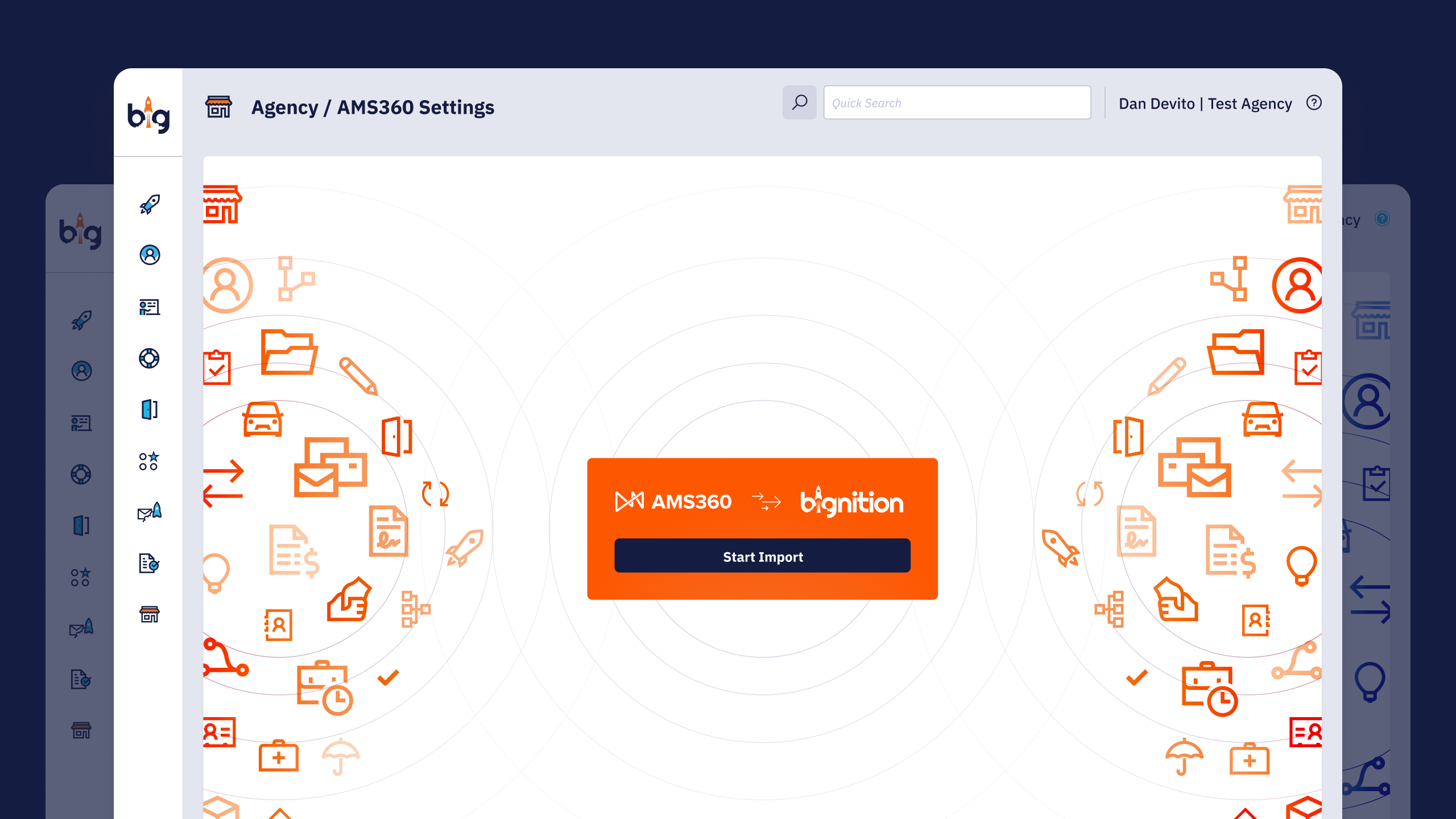
Bignition is one place we have done this work. We redesigned and expanded their commercial insurance platform for independent agencies, where every decision an agent makes spans multiple systems: prospecting tools, pipeline data, agency management software, carrier feeds, commission and policy records.
Instead of replacing the platform underneath, we built a layer on top of it that lets agents see the operation as one thing. The work included:
- An overhauled dashboard
- A game plan wizard for goal tracking
- RHI referral flows
- New business revenue scenarios
- Policy and commission screens
- Carrier data import capabilities
All of it built while maintaining compatibility with the AMS360 agency management systems the agencies were already running.
That last part is what matters most. Bignition shares context with what was already there, so agents do not have to reconcile between Bignition and the system of record.
The two layers are talking to each other. The agent sees the pipeline, the relationships, and the projected revenue in one place because the system carries the context that used to live in someone's head.
That is the difference between adding software and improving the architecture.
How to tell if your architecture is ready for more AI
Before the next AI investment, the questions worth asking are not about which tool to buy:
- Where in your workflow is context getting dropped between two tools today, and who is reconciling it by hand?
- Which manual step exists only because two systems do not share state?
- When one of your automations fails, how long passes before anyone notices?
- Who owns the seam between your customer system and your operational system, by name?
- If a definition changes in one tool tomorrow, what else breaks before anyone catches it?
If the honest answers describe more manual work and less clarity than you would have expected, the architecture is not ready for more AI on top of it.
The next layer will amplify whatever is underneath, and that cost will be higher than building the foundation right in the first place.
Three things to do before the next AI contract
You do not need a six-month project to act on any of this. Three small steps before the next contract gets signed will get you most of the way there.
Trace one workflow end to end. Pick an operation that already has AI on it and follow a single record from where it enters to where it leaves, through every tool it passes through. Mark the spots where someone is currently reconciling it by hand. That map will show you where the next AI investment will pay off and where it will just create new problems.
Find the most expensive seam. Of those manual catches, which one is costing the most time, attention, or rework this quarter? That seam is your highest-leverage problem, and the one most likely to consume the next AI investment if you do not fix it first.
Bring it to the next vendor meeting. When the next vendor proposes adding AI to that workflow, ask which of the manual catches you mapped their tool will actually eliminate, and which it will leave in place. A vendor who says all of them has not understood your operation, and that is useful to know before you sign anything.
The companies getting the most value from AI are not necessarily the ones adding the most tools. They are the ones reducing the amount of coordination work their teams have to do between systems.
As AI scales, operational complexity does not disappear. In many cases, it just becomes harder to see.
Workflows look faster on the surface while employees still spend time checking outputs, reconciling inconsistencies, and carrying context between disconnected platforms.
The organizations that scale well over the next few years will likely not be the ones with the most automation.
They will be the ones building systems that communicate clearly enough that humans no longer have to fill in the gaps between them.
Related Articles
Here are a couple related articles to view, or return back to the main page.



Check out the BIZ/DEV podcast
Our weekly tech podcast focusing on AI, our industry, the founder's journey, and more.