Bob and Weave w/ Jake Harris
In this episode of Biz/Dev, we sit down with Jake Harris, founder of buildwallet, to talk about trust, innovation, and what it takes to introduce entirely new ways of thinking to an established industry.
Jake shares his journey from construction entrepreneur to blockchain advocate, why trust remains one of the biggest challenges in project delivery, and what he's learned from building a new category around project wallets.
[00:00:00] Jake: And that's where I fell in love.
That's where I saw the future. And I said I'm gonna dedicate my life to building this. This is important.
[00:00:09] David: Hi everyone. Welcome to the Biz Dev Podcast. The podcast about developing your business. I'm David Baxter, your host, joined unfortunately by Gary Voit. Hello sir.
[00:00:18] Gary: Yeah. Yeah. What's up? Hi.
[00:00:20] David: He's keeping it short. He's shy. Folks. More importantly, we are joined by Jake Harris, who is the founder and CEO of Build Wallet. Hello, sir. Welcome.
[00:00:30] Jake: Oh, thanks
for having me and excited for this conversation.
[00:00:33] David: So we start off with questions to say get to know you a little bit better. They have nothing to do with anything. I'm gonna start off easy. iPhone or Android And why? See the second part's better.
[00:00:44] Jake: Android so wife can track me.
[00:00:45] David: Okay. That's fair. Do you have, is
[00:00:49] Gary: you could track people on iPhone.
[00:00:51] Jake: Yeah, that's true. But she doesn't want to hear that. It's, she got everybody in Android so she could track the whole family.
[00:00:56] Gary: Okay.
[00:00:57] David: it's a family thing with a, I find it's not a choice. It's a fam, it's not an individual choice. It's a family choice for the
[00:01:03] Jake: It does become family choice for sure.
[00:01:05] David: All right. Are you the type of person who takes notes or do you just, do you use the AI recorders nowadays?
[00:01:12] Jake: I think there's something about handwriting notes and having to push my brain to actually move my pen and distill what's important versus what's not important. So yes I'm a notebook note taker guy. I always have a notebook with me.
[00:01:25] Gary: Good
on you.
[00:01:27] David: derail the entire podcast, but I find note taker people are also pen people. Do you have a go-to pen?
[00:01:33] Jake: I do the uni ball, black thin. Yeah. So yeah, that's yep.
[00:01:39] David: I know that I tried
[00:01:40] Gary: That's a pretty astute observation. David.
Congrats on that.
[00:01:44] David: those every once in a while. Yeah, I wanted to be a pen person and I actually bought my entire team as a anniversary gift. I think the pen that I chose, it was, does you still have yours?
[00:01:53] Gary: Yeah, the Baron Fig Excalibur.
[00:01:56] David: That's a great pen.
But then I lost it and now I don't write anything. that's just how that worked. Alright, last one. Favorite sport to play or watch?
[00:02:08] Jake: Watch hockey play lacrosse.
[00:02:10] David: Oh, look, he's athletic. I don't know anything about, I can't relate to him at all anymore.
[00:02:14] Gary: Lacrosse is like hockey, but in the air with a ball
on a field.
[00:02:18] David: is. If he had said Hili, I would've been super impressed. But,
[00:02:21] Jake: that's how my lacrosse coach described it too yeah.
[00:02:24] David: It's hockey, but we picked the ball up.
[00:02:26] Gary: I'm just joking around.
[00:02:27] David: I've always been impressed when I had a, there was a friend of mine who went to college playing lacrosse and all the time he had his little stick and he would just keep bouncing against the wall and catching it back and forth.
That was like, he did that constantly. Thankfully I was not his roommate or suitemate that would've driven me nuts, but it's an amazing thing to watch the, how they do all that spin around and stuff like that. Alright, we're done with the hard questions now on the easy stuff. Tell me about Build wallet.
[00:02:52] Jake: Born out of necessity. was messing around and I had created an analog option and then I went to a friend and said, it's 2019, there's gotta be a better way to do this. And he pointed me to a tech guy and that was six years ago and we're still on the journey. And yeah, a contractor, I was frustrated with the way that we handle and manage cash flows.
I was opening up bank accounts for each one of my projects, both commercial and residential, telling the owner and being like, Hey. Why don't you go ahead and fund the bank account and if you fund the bank account, I can pay all the subs instantly. We can move this project super rapid and everything will be good and we'll be friends and at the time.
That we started and we kept doing it. I had seven checkbooks with seven different debit cards, and my accountant wanted to kill me, and my wife wanted to kill me. And I'm running from tailgate to tailgate, making checks on the wrong checkbooks and having to make adjustments and everything else. And so I finally went to a friend and I said, this is 2019.
And I said, there's gotta be a way that we can put this on the phone. And he introduced me to something called blockchain, which is a very foreign concept as far as use case. And he goes, you can, but everyone needs to get a wallet and we gotta put it on blockchain. And that's where I fell in love.
That's where I saw the future. And I said I'm gonna dedicate my life to building this. This is important.
[00:04:09] David: All right, so now I have so many questions.
[00:04:12] Gary: Yeah, me too. Me too.
[00:04:13] David: I wanna understand the basic premise 'cause I'm not in your world at all. You're talking about construction, right? So I am a general contractor. I assume is the person who's using this, the way you described it, and I'm building, let's say a house, and I've got 20 subs that need to be involved in building the house. The pain point that you just described was paying them was difficult. Why not just use Venmo or something like that?
[00:04:37] Jake: It actually comes back.
[00:04:38] David: however, yeah.
[00:04:40] Jake: All of that's very reactive. And, and I'm
a very, I'm a very proactive person. I renovated hotels for some of the largest brands over 10 years, and so speed was very important. Systematic was very important. So I lived in Microsoft Excel, Microsoft Project and I realized that by planning out as much as I could, I felt safe.
I, I wanted to protect. But the problem was that even as much as I planned, as, as well as I planned out the project. Things could still go awry. And the input of money, which is the most important input we have in a project could be derailed. And so what we realized was is that Build Wallet is the name of the company, but we needed to create a new category.
And so we call the category project wallets because that's what everyone's gonna call it. They're gonna say, Hey are you're doing this job? We're doing this thing. Why don't we just open a project wallet? And a project wallet is exactly what it sounds like. It's a wallet for the project. So in blockchain world, the table stakes in order to get in are you have to have a wallet and a set of keys so that you can receive.
Digital assets and send digital assets. So everyone has a wallet. The project has a wallet, and we figured out how to automate using the contracts. We figured out how to automate the cash flow through the wallet.
[00:05:56] David: Alright, So lemme see here.
I hear crypto. Tell me where I'm wrong. 'cause I'm pretty sure I'm wrong.
[00:06:03] Jake: That's not wrong. It's just been the best use case. So if you think about, and I gave this example when I was talking to the finance directors of the National Home Builders Association. Blockchain is the nail gun, crypto is the nails. And so the machine that we use if I were to give somebody a definition of what the blockchain is, it's an engine that runs around the world every second.
And if you want to attach a digital asset to you, to this engine and send it to your friend in Shanghai and Seattle and San Antonio, it can be there within an instant of a second. And so that's the functional use case. The machine is what I'm interested in. The coins and the cryptocurrency are the packages, the things that are being delivered.
And then you have market based versus stable coins, but it's, can we use this infrastructure, this rail system that travels around the world every split second in order to program money and deliver money faster?
[00:07:03] David: But if I'm your sub, you're paying me in crypto. Or can you pay me with dollars?
[00:07:08] Jake: Yes. The funny thing about good technology is that it's indistinguishable from magic. And so what we wanna do is we wanna make it so simple that the sub doesn't even need to know anything about crypto. They receive, so the owner takes a hundred thousand dollars, they what's called minting. They mint a hundred thousand dollars in stable coins.
One stable coin equals $1. The owner and the contractor do the automation. They pass out all these coins. The guys do the work, and the subcontractor, the painter receives five thou 5,000 of these coins. He pushes a button and he returns them to the person who issued the coin offering the ICO or the teller, if you will, at the bank or the teller at the cage, at the casino.
And then he receives the $5,000 in USD. So they don't know that they're transferring in crypto. Matter of fact, a lot of the stuff that we do in the banking system is currently transferred on the blockchain. We just don't know it 'cause they don't tell us about it.
[00:08:06] David: Okay, so from a practical perspective, the
[00:08:09] Gary: It's like an escrow account.
[00:08:11] David: They're not, they don't have to have open up some crypto and go to Coinbase and all that
[00:08:15] Jake: Not at all.
[00:08:16] David: It's just money
[00:08:17] Gary: the fluctuation in the market does not affect them or their payment in any way.
[00:08:20] Jake: That's the difference between the category and the company. So the category, the project wallet, is the concept of using blockchain and having, giving the ba, giving the project its own wallet. The company. What we do as a company is we set everyone up with their own self custody wallets. We train them, we get them comfortable, we put the, the keys, get on their phone, we give them everything they need, and then we help them through the process using the automation.
So there's a split between what the category does and what the company does.
[00:08:51] David: So can't imagine though that, blockchain because of it's so synonymous in most people's mind with crypto. And NFTs and all of that stuff, which kind of has some baggage nowadays. How is, I would assume that you've got a lot of, you gotta convince people look, I'm not selling you a big yacht, ape, or whatever image, that trash that was so big during COVID,
[00:09:17] Gary: It's not NFTs. Yeah.
[00:09:19] David: because. You have to explain. No. We're not creepos, right? We're not weirdos. We're not stealing your money. All that. No. We have a cool service and here's how it works. Has that been a real thing for you?
[00:09:30] Jake: Yes and I hesitated to bring this up and against many people's advice. They said, you shouldn't bring up crypto, you shouldn't talk about it. You shouldn't bring it up. And I said, look, the problem is that people have assumptions, right? People have baked in assumptions based on what you talk to them.
So when you start a conversation with somebody and you say something as simple as, we're automating contracts and cash flow. They hear SaaS and banks. That doesn't really work well. So the opportunity was I had to shift them out of their current paradigm, and I had to say no. This is a different thing.
Now, here's the challenge that I have, being a new category in today's world, if you're over 45, this conversation gets stale very quickly. I this product this category, is really built up for the native digital project managers. Somebody who's explored cryptocurrency, somebody who understands that they can actually hold a digital asset, a value proposition in the digital space.
And they can trade them amongst their buddies. 'cause when I talk to the native digitals, they go, oh my gosh, this is a brilliant use case. This is what I needed. Where have you been all my life? And so the hardest part of creating a new category to your point is the education part. What I found and I just stumbled upon recently, was the idea that there are companies out there that are now coining the phrase and are targeting and hiring people specifically for a single job.
And I met with these guys and they're called, and girl, they're called the directors of innovation. So here you have legacy construction companies. They've been around for many years and they understand that if they don't innovate, they're gonna die. And they've actually tasked a single person who's typically younger, who's typically very good and has a growth mindset as opposed to a fixed mindset.
And this person is tasked with going out and bird dogging new ideas, bringing them back into their office and testing them out. These people are my people. These people wanna talk about innovation. These people wanna talk about how to change how people think, feel, and act in their organization, how people think, feel, and act on their project sites.
And when I start showing them what a project wallet does to a project team. They go, yes, this is what we want. This is what we need, this is how it goes. So it all comes back to what's the objective? What's the objective of the owner? What's the objective of the contractor? What's the objective of the sub?
What's the object? These people are so focused and we've been so focused for so long on just doing the work. That, and it keeps getting harder and harder. That when something comes along and actually makes it easier by thinking about it, because you're automating contracts, which we call goals and cashflow.
The rewards. Now we're using psychology now, we're now we're tapping into people's psychology and their intellect. To sit there and make it easier for them to actually do the work and execute. So education is 100% my biggest job. But I'm finding easier ways to talk to people when I start using simple language.
And that's why it was so interesting for me to come on and talk about this because there, there are other people in your market and the people you talk to that may have come up with something completely innovative, but don't understand that creating a category is a very different than just creating a company.
I've created companies for many years. Creating a category is ridiculously hard, and there's resources out there, different books, different people. Finding those people and latching on is the only reason I'm still here. I would've died 10 times over.
[00:13:04] David: So you are, essentially you're calling a category, but you're basically describing just first mover, right? You're create, you're blazing the trail. I have found just by being old is you have two options to be a first mover. You can be an evangelist, it sounds like the role you've picked up, but that person, usually that's, that company is ahead of their time and they often die because they're out there not making money.
Just letting everybody know they're educated. In everyone, or you could just be so duh. Like an Airbnb being a good example. They were definitely a first mover, but people were like, sounds cool, and just jumped on. And then the second movers come on in and. That seems like not the way that yours, yours is legitimately difficult. a lot of, that's a very tech, technically savvy thing. You have to understand. if I am a non-technical person, I guess where I wanna wrap my head around it. I'm just a dude who wants to manage my project. I don't care about tech, I don't care about any of this stuff. What benefit do I get by using you?
Like gimme my practical, I'm just a guy with a truck trying to get my job done. my practical benefit of using Build
[00:14:21] Jake: Clear goals, fast rewards.
[00:14:23] David: Okay.
[00:14:25] Gary: No waiting for payment from
[00:14:26] Jake: that?
[00:14:27] Gary: the
[00:14:28] Jake: psychology. Behavioral psychology tells us that if you can provide clear goals and fast rewards, you can change people's behavior and you can get them to want to lean in. And the coolest part about what we've done is we've watched subcontractors use the platform and then ask other people that they work with, Hey, can I use this to get paid?
And most of the time, subcontractors have zero benefit to any technology. 'cause the technology always benefits. The general contractor or the owner, or the lender, but the majority of the project is executed 80, 85%, 90% of the project is executed by the S and suppliers. So we've by helping them, we're helping the entire team and that's the virality that we were after.
We want the subs to start recommending us as well.
[00:15:17] David: If I am the general contractor, I pay my guy, my painter, that money happens immediately. Now I'm the painter, and I want that actually to be in my bank account. Is that still that two to three day float? Because the bank is a pain in the butt,
[00:15:32] Jake: Stable coins are an instant redeem. And so because it's digital asset, wallet to wallet that's instantaneous. And then you push the button, the painter pushes the button and the money moves from their stablecoin wallet, self custody stablecoin wallet. Back to the ICO the initial coin offer, which is a fiat.
He, he's got money in the bank, he's got it backed one-to-one, and he transfers the money to the painter.
[00:15:58] David: So I can get paid and go to my bank and withdraw that cash within moments.
[00:16:06] Jake: We've made it to the point where the tile guy can be on the job site, he can finish the work, he can submit the invoice with his phone. The contractor could be standing over him, hit the approved to pay button, and he can have money in his bank account before he hits his house.
[00:16:22] Gary: Nice.
[00:16:23] David: Nice. Yeah, I wish I got
[00:16:25] Gary: Is there any friction in I guess the subcontractors, doesn't matter what banking systems they use or any of that, or.
[00:16:34] Jake: And back to David's point. I've been at this for six years, so three years ago, this was a very different conversation. Two years ago it started getting easier. Now people are understanding after all the head top dogs and everybody understood that blockchain was a good thing. Now we have much better relationships with all the major banks. They understand that stablecoin distributions basically taking a stable coin and turning it back into a US dollar. Happens all the time. They receive it, they accept it, they push it. Everything's good.
[00:17:11] AD: We believe that business is built on transparency and trust. We believe that good software should be built the same way. Big Pixel is a 100% US-based fixed fee, custom software design and development agency built on transparency and passion. No offshore handoffs, no surprise invoices, just a team that treats your problem like it's our own.
UX and design are core to everything we do. Not a phase that gets handed off, but a discipline that runs through every decision we make. We bring the expertise to build what your business needs and the clarity to know when AI and technology help and when they get in the way, we provide our clients honest assessments of where they are and how they can get where they want to go.
Your idea deserves the right team. Let's talk plan and create something that truly works for you.
[00:18:06] David: So backing up, okay, so I understand you're doing a category, but you're also business, right? You're six years in. How's it going? Are you guys on a runway? Are you guys self-sufficient? Are you guys killing it and taking names? Where are you guys at?
[00:18:20] Jake: Bootstrapped because I'm a contractor still. Um,
we, I've suffered so many death defying feats between my co-founder quitting my tech team, revolting our backend banking structure at the, at back in 2024, quit and left. And so we've done a lot of the Bob and Weave, but. It's a calling. Everyone I know and a lot of, even my tech advisor and everybody else said I should have been dead by now.
But I feel called to put this out in a missionary capacity, an evangelist capacity, because I believe this can change people's lives for the better.
[00:18:58] David: I've heard that before from other blockchain advocates. What is it about that technology makes people so devoted, for lack of a better term.
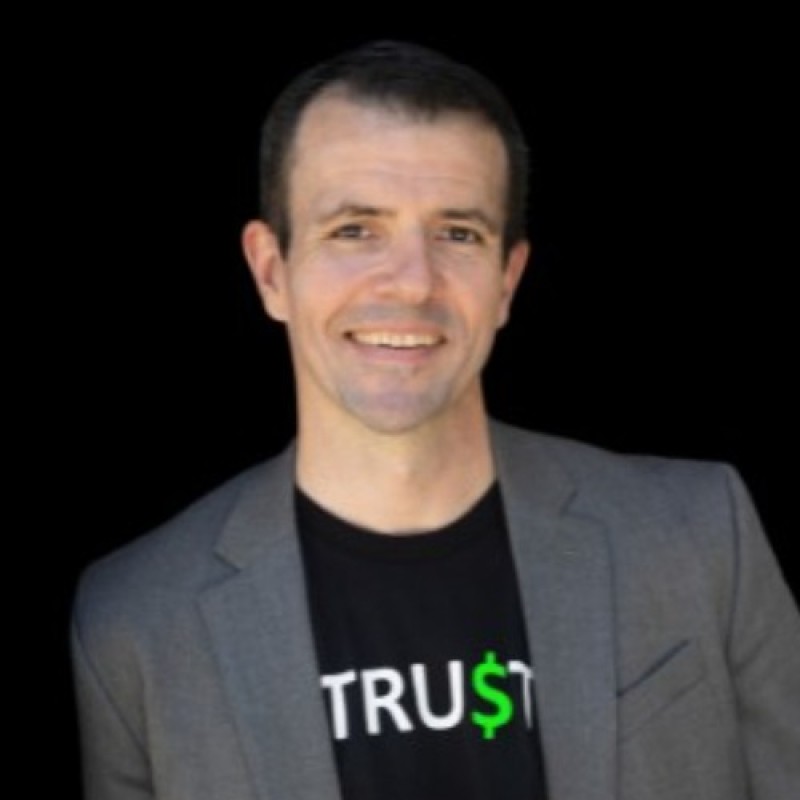
[00:19:08] Jake: Trust if you read anything on blockchain, you'll see that word trust our. When I tell people what the product of Bell Wallet is, I tell 'em, it's trust only. I've switched the s for a dollar sign. So you'll notice on my t-shirts, on my languaging, on my documentation, I'm not prom, I'm not delivering a product.
I'm delivering a feeling to these people. And I think that's what blockchain as a community does, is that there's no more middleman, there's no way to since these are programmable money. There's no way to play games. There's no way to, to use the float. There's no way to benefit other than the intended purpose.
You could take a dollar and write, 1, 2, 3, any street demolition, phase one invoice one. That dollar has to go to that project where that purpose, that's what we're talking about with programmable money. And that's the feeling that everyone gets when they participate, is trust.
And that feeling is the number one most important thing in high performance teams trust clear goals and dependability. Those are the top three things. We give all three of those in a project wallet. That's our that's what automate contracts and cash flow talks about.
[00:20:19] David: Was fascinating. Gary,
[00:20:22] Jake: not a tech person. I'm a contractor that just was introduced to this and have decided that this is what my industry needs. I need to make this happen. It's very important.
[00:20:31] Gary: It seems like you do still have a bit of a hill to climb. 'cause I'm sure in the general public's mind they hear. Bitcoin every time you say, you know, and then the, the trust part doesn't quite come across immediately. So even the word stable coin makes it seem like, well, that's just marketing for the same cryptocurrency, their calling is. Yeah, I understand that the education part's gotta be pretty, uh, what's the word I'm looking for? Pretty aggressive and also convincing at the same time, but. Hopefully you, that it works for some of the subcontractors and then like you said, word of mouth and that kind of spreads throughout the community there.
So hopefully that's the wind behind your sails on that.
[00:21:15] Jake: In diffusion of innovation, it's a bell curve. And so the first 16%, the only 16%, the innovators and early adopters, those are the only people that will actually try something without knowing somebody who's tried it before. So when you think about how do we actually move, how do we actually change the industry?
How do we change anything? It's the innovators and early adopters that I'm focusing on. I'm finding those people who are looking for something new and are willing to try something that they haven't seen before. They don't know somebody who's tried those kinds of things. And it's 16% of the population. So I go to my conferences and I go to these meetups, and I know out of a hundred people, there's 16 people that I can even spend any time with.
The other people are early majority, late majority laggards. They like it the way it is. So finding those innovators, fi working on crossing the Chasm, working on Everett Rogers, finding those innovators and early adopters is all I'm doing right now.
[00:22:11] Gary: Yeah. Now you mentioned that you've had some ups and downs when you started this company and moving to where you are now what would you give as your three pieces of advice for someone starting a new business or a new company, or maybe even in fact, a new category?
[00:22:28] Jake: You're not alone, right? So the three things, and they sound very generic, but I really do believe in them, is that I think that you need to read. And you need to read business books in order to understand the theory, but then read autobiographies to understand the application. So I read a lot of the Genius Collection by Walter Isaacson.
I read a lot of innovative books on people that change the world. And then I go and study how they did that and compare them with the business books that talk about the theory behind it. Uh, find associations go discuss this with people, find other people's problems and solve their problems. I love it when people have problems that I get to pitch in and help out because iron sharpens iron.
It helps me make solve problems on my side. I've done that more than once where I've helped somebody solve a problem and then used a similar solution or unlocked a solution on my side. And then the last thing is find somebody who's a couple steps behind you and help bring them forward. Teaching is learning twice over.
If you can take what you know and take what you've learned in the past, six months, year, two years, 'cause it's advancing so quickly and teach somebody else, you're gonna be all that more proficient and you're gonna turn around and help somebody else. So it's really just comes down to read, discuss, and teach.
[00:23:39] Gary: Nice. Jake, if anybody wants to learn more about you or about Bill Wallet, where's the best place to find you?
[00:23:45] Jake: So two parts. You've got project wallets.com. That's our category blueprint. We've written the entire thing out. So if you're in the project space or you wanna learn about how we can use blockchain to leverage and automate and automate contracts and cash flow project wallets.com. And then build wallet.com is where I stay.
Book a demo. I'd love to show you what we're building here in this space.
[00:24:06] Gary: Awesome. We'll make sure those links get into the show notes as well, so everybody will be able to just click on 'em right there.
[00:24:10] Jake: Fantastic.
[00:24:12] David: This has been a lot of fun. I've learned a lot. Wow. a lot. This is a good one. I appreciate your time. Thank you so much. Your passion's. Notable man.
[00:24:19] Jake: I appreciate that very much and thank you for having me.
[00:24:22] Gary: Thanks, Jake.
[00:24:23] David: And on that note, we are out. We will be back next week. Everybody have a good one.
[00:24:27] OUTRO: That wraps up this episode of the Biz Dev Podcast, and this time you get me, Scott Bailey. I'm the lead dev over here at Big Pixel, and I know what you're thinking. I thought David did all the work. Well, not exactly. We have an awesome team of people to back in both. Biz Dev is a production of Big Pixel, the US based provider of UX design strategy, and custom software.
This podcast is edited by Audio Wiz Matt McCracken and Christie Pronto marketing guru for Big Pixel. Want to connect? Shoot us an email at hello@thebigpixel.net. Or you can find out some Instagram, Facebook, YouTube, X and LinkedIn.
Recent Episodes
Here are a couple other episodes to check out, or return back to the main page.



AI, Tech, and Industry News
Check out the latest insights, curated with intent, from our team.