When Software Stops Matching the Way Your Business Actually Operates

When Software Stops Matching the Way Your Business Actually Operates
At twenty employees, your CRM was the right answer.
The team was small enough that everyone in it understood what every field meant, and the platform was built for a company that ran the way yours used to run.
Three years and one hundred eighty hires later, the CRM is still in place, and most of the meetings about how to use it are now about how to work around it.
The platform did its job.
The business changed shape underneath it.
At some point in the last eighteen months, the software stopped supporting your operation and started shaping it, and nobody in the room called it out by name because it happened one feature request at a time.
Why your software stopped fitting
The reason this is happening to so many companies at once is that the software market is going through a structural shift, and most platforms in your stack were designed before that shift was visible.
For the last decade, the playbook was simple. Buy a monolithic platform for each major function: a CRM for sales, an ERP for operations, an HRIS for people, marketing automation for marketing.
Each platform was built to be the single source of truth for its domain, and the buy-and-implement cycle assumed the business would adapt its process to the platform's model.
That worked when the platform was meaningfully ahead of where your operation was, and it worked when the business changed slowly enough that the platform could keep up.
Neither condition holds anymore. Two things changed at once:
- AI is moving what software can do faster than any vendor roadmap can absorb. Capabilities that did not exist eighteen months ago are now table stakes, and the platforms in your stack are mostly catching up by acquisition or by tacking on a co-pilot.
- Businesses are reshaping themselves on a six-to-twelve-month cycle now, instead of a three-year one. Headcount, pricing, go-to-market motion, segment, operating model: all of it moves faster than the platform's release schedule can match.
The platforms that were built to hold the source of truth for a decade have to be updated every quarter to keep up, and the gap between what the platform can do and what your business needs shows up as workarounds, exceptions, and friction inside every workflow.
The industry has named the response: composable architecture.
Connected ecosystems of specialized tools and custom layers, in place of one platform that tries to do everything. You can see it across categories:
- Commerce
- Data tooling
- Dev tools
- Marketing automation
- Internal operations platforms
The trend is consistent across all of them for one reason.
Monolithic platforms cannot keep up with the pace at which businesses change shape.
How to tell when it is happening to you
The shift from "the software supports our operation" to "the software shapes our operation" rarely announces itself.
Leadership usually notices it as a feeling first, a sense that the company has gotten harder to run despite having more tools than ever. The signs are specific once you know where to look.
A few of the most reliable ones:
- Reports are routinely two cycles late. The business runs on weekly numbers, but the report comes out monthly because that is what the platform supports. The team has stopped asking for the cycle they actually need.
- New workflows require a workaround inside the platform itself. Sales builds custom objects, finance creates approval queues outside the system, ops keeps spreadsheets to track what the official tool cannot represent.
- The team maintains a parallel record. A shadow CRM in Notion, a separate forecasting spreadsheet, a side ledger in QuickBooks. The official tool is the system of record. The parallel record is what people actually trust.
- Integration breakage has become routine maintenance. Every time the upstream system updates, somebody on the team spends a day repairing what broke. Nobody calls it work anymore because it is just what Tuesdays are.
- Hiring criteria warps toward platform skills. The team starts hiring Salesforce admins, NetSuite consultants, or HubSpot specialists at a rate that has nothing to do with the size of the actual business problem. The platform itself has become a hiring pressure.
- Strategic decisions get framed around what the software can do. Someone in a planning meeting says "we cannot do that because the system will not let us," and nobody disagrees. The conversation moves on without naming what just happened.
If three or more of these are running in your operation, the software is no longer fitting the way the business operates.
The cost of bending the business to the software
When the software starts shaping the operation instead of supporting it, the cost lands in places that are hard to see on a P&L.
Strategic flexibility shrinks first. New product ideas get sized partly by what the platform can do, not by what the customer needs. Pricing changes get held back because the billing system cannot represent them. The team that should be pushing the business forward ends up scoping every initiative around platform limits, and over time the company stops trying things the software does not natively support.
Decision quality goes next. In a planning meeting, the question "what is the right thing to do" gets replaced by "what is the thing the system will let us do," and the substitution is so smooth that nobody on the team notices the question changed. The decision still gets made. The decision is just no longer the one the business needed.
Trust takes longer to erode, and it is the cost hardest to rebuild. The platform stops being a tool and starts being a constraint people have to work around. The finance lead spends half her week explaining what NetSuite will and will not let her do, the marketing lead justifies every campaign idea against HubSpot's data model, and by the time the same conversation has happened across three functions, the team has stopped seeing the software as their software.
We believe that business is built on transparency and trust, and that good software is built the same way.
The software stops earning that trust the moment it starts dictating answers the business did not ask for.
By the time a team has gotten used to operating around it, the question has stopped being whether to fix the software, and started being whether the software belongs in the operation at all.
The question worth asking
The question every leadership team has to ask, before any platform decision gets made, is one sentence long.
Is our software supporting how we operate, or determining how we operate?
If the honest answer is "supporting," the platform is doing what it was bought to do. The right move is to maintain it, monitor it, and extend it as the business evolves.
If the honest answer is "determining," the platform has crossed a line that costs more than it is saving.
The next decision is whether the platform earns its place in the business at all, and features and pricing matter less than that strategic question.
There are three real options when the answer is "determining":
Rebuild purpose-fit. Replace the platform with software designed around how the business actually operates today. The right move when the existing platform's data model, workflow logic, or extensibility cannot be brought into alignment with the business without bending one or the other beyond the point of recognition. Expensive up front. Cheaper over time, because the build absorbs the workarounds that the existing platform required.
Compose around what works. Keep the parts of the existing stack that are still earning their place, replace the parts that are not, and build a custom layer that connects them around how the business actually runs. The right move when the platform is fine in some functions and broken in others. Lower-risk than a full rebuild. Higher-skill on the architecture side, because the composition has to hold together as the business keeps changing.
Walk away from the platform. Stop using it and replace it with a smaller, more flexible alternative. The right move when the platform's pricing, lock-in, or strategic direction has diverged from the business and no amount of customization will close the gap. Sometimes the cheapest option, and almost always the one that surfaces the most internal resistance, because someone signed off on the original purchase.
The honest answer to the question above is what makes the decision.
The option follows from it.
What this looks like done right
We have seen the "determining" version more times than the "supporting" version.
The pattern is consistent, and the rebuild is what we do when the platform's days are numbered.
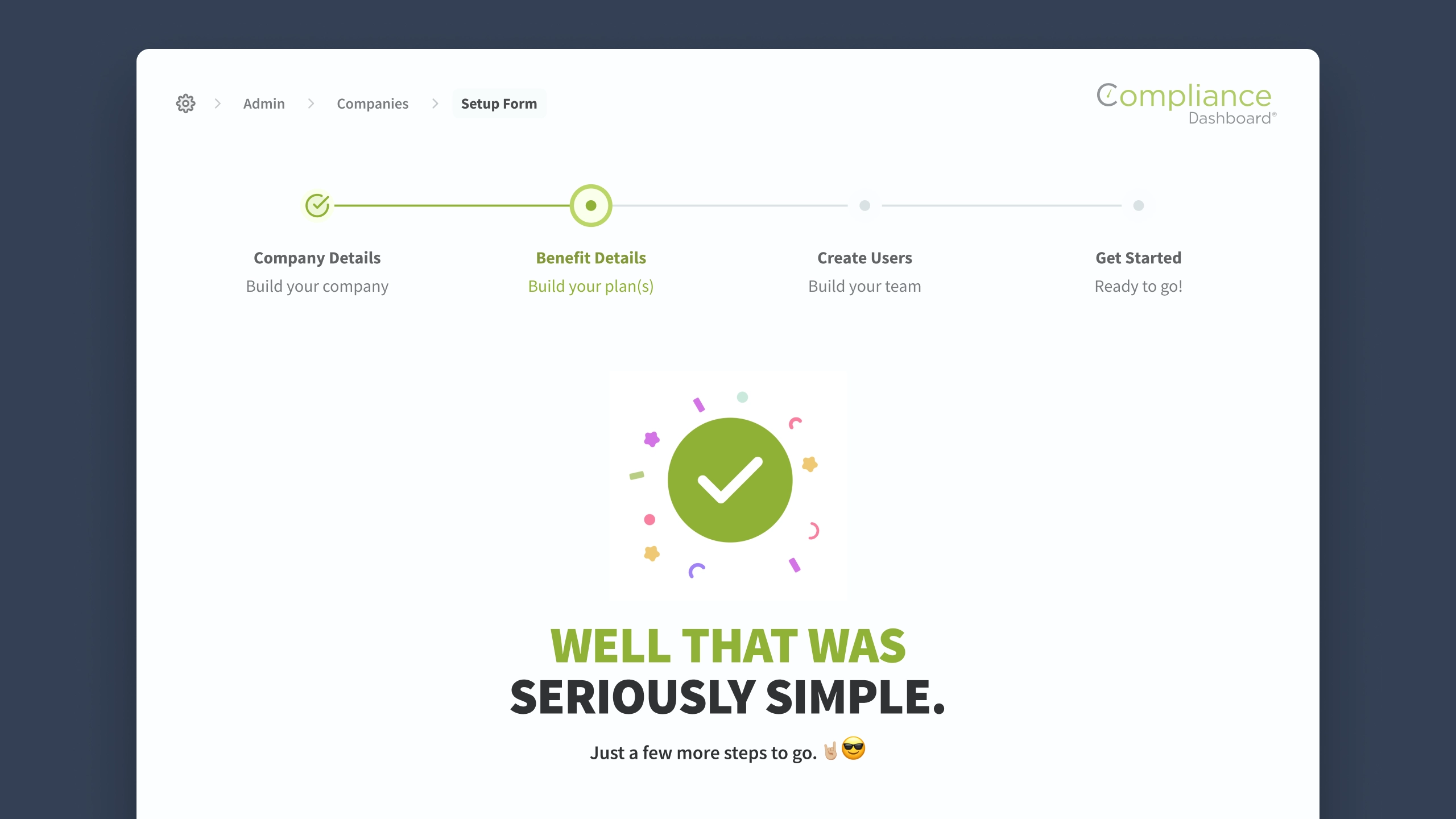
ComplianceDashboard came to us with a twelve-year-old WordPress system that had once been the right tool. The business had grown into a shape WordPress was never designed to hold:
- Multi-step onboarding wizards capturing 80+ fields per company
- Compliance workflows that needed weekly emails sent in the tens of thousands
- A product layer no off-the-shelf platform supported without heavy customization
The team was running the operation by carrying institutional knowledge that the old system could not capture, and every new requirement that came in had to be slotted against what WordPress would allow.
We rebuilt the platform from the ground up.
The new system sends more than 20,000 emails a week, handles the onboarding fields and workflow logic the old one could not, and the team is no longer the layer holding the platform together.
The operation runs on software designed around the business as it actually is today, with the workflow logic, data model, and capacity the business needs.
The discipline of the rebuild is the part most companies underestimate. We start every engagement by mapping how the operation actually needs to work today, and we design the software to that map.
The map drives the data model. When the business changes shape again in two years, the same platform can absorb the change instead of becoming the next workaround layer.
That is the difference between software that supports the operation and software that determines it, at the strategic level and at the operational one.
Where to start
You do not need a board approval to find out whether your software has stopped fitting. You need an hour with the leadership team and the honest answer to two questions.
Question one. Is the software supporting how we operate, or determining how we operate?
This is the one the whole strategic decision turns on. If the answer is "supporting," the rest of this is not your problem yet. If the answer is "determining," buying the next platform will not change what is happening, and the next AI tool will land on the same misaligned foundation as everything before it.
Question two. Run the six-sign diagnostic against each platform in your stack.
If three or more signs are showing up for the same platform, the software has crossed the line in that function. Rank the platforms by how many signs each one is triggering. The one with the most triggers is the one to address first.
The pressure to add AI is real and it is not going away. Boards keep asking. Competitors keep announcing.
The path of least resistance is to layer a model on top of a platform that is already shaping the operation in ways nobody named, which produces faster bad decisions on top of the same misaligned foundation.
If your team has been routing around the software for months and you are about to approve another tool to sit alongside it, the cheaper move is the conversation about whether the existing platform still belongs.
Whether you take that work on inside the organization or bring it to a firm like Big Pixel, the question is the same.
Is the software supporting how we operate, or determining how we operate?
Answer that honestly and the platform decision falls into place.
Related Articles
Here are a couple related articles to view, or return back to the main page.



Check out the BIZ/DEV podcast
Our weekly tech podcast focusing on AI, our industry, the founder's journey, and more.