Magnetic Appeal w/ Emily Gerhardstein
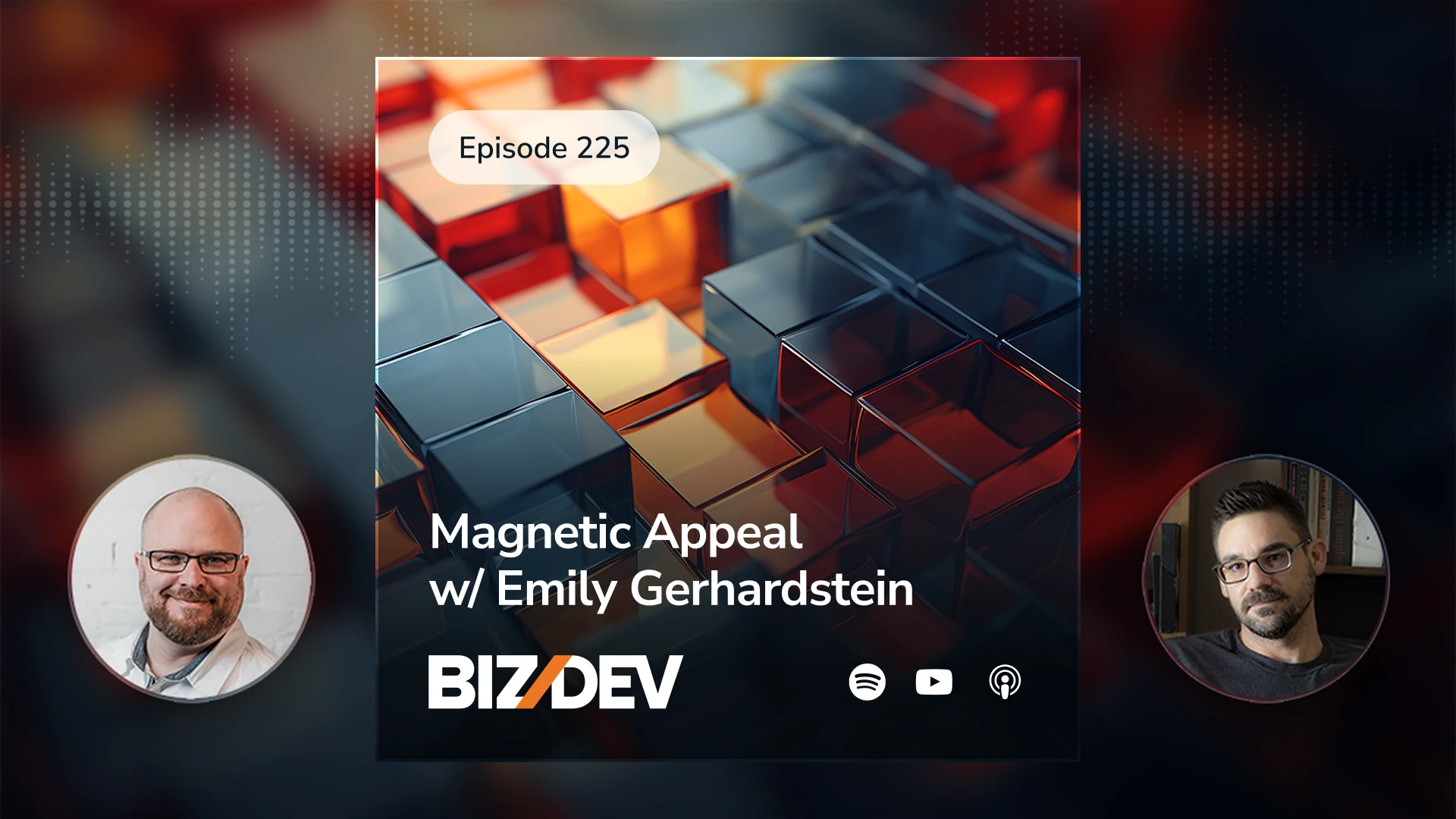
Emily Gerhardstein
CEO & Co-Founder of LS Adaptive
In this episode of Biz/Dev, we sit down with Emily Gerhardstein, CEO and Co-founder of LS Adaptive, to talk about building a mission-driven company at the intersection of healthcare, fashion, and innovation.
Emily shares how her experience as a caregiver inspired the creation of LS Adaptive, why inclusive design benefits more people than we realize, and what it takes to build products that solve real-world problems with dignity and independence in mind.
Along the way, we discuss bootstrapping a startup, creating a new category in the market, and how personal experiences can become the foundation for meaningful innovation.
[00:00:00] Gary: And David just privately DMed me, where can he get some magnets for his pants?
[00:00:04] Emily: Come online.
[00:00:05] David: So rude. Oh my gosh, man. That was a good one.
[00:00:14] David: Hi everyone. Welcome to the Biz Dev Podcast, the podcast about developing your business. I'm David Baxter, your host, joined Per Usual by Gary Voight.
More importantly than my shirt, even though it's a great one. We are joined by Emily Gearhard. Stein. Did I do that?
Did I do it?
[00:00:30] Emily: Yeah, that you did it. You did well.
[00:00:33] Gary: Emily G for those who know.
[00:00:35] David: she sounds like a rapper.
[00:00:37] Emily: I am cool with that.
[00:00:38] David: that then
[00:00:39] Gary: You should have said I'm cool like that. Then it would've been a double.
[00:00:42] David: Emily is the CEO and Co-founder of LS Adaptive. Welcome, and thank you so much for joining us.
[00:00:48] Emily: Thank you so much to David and Gary for having me be here today.
[00:00:51] David: So I am gonna start with some intro questions. We like to do this to get to know you a little bit better and ask you random stuff. See how you handle it. Alright. You ready?
They're not
[00:01:02] Emily: Ready? Let's do it.
[00:01:04] David: Let's
[00:01:04] Gary: it. is a test. You will be graded.
[00:01:06] David: You will be graded and may maybe fired.
[00:01:08] Gary: This might go on your permanent record.
[00:01:11] Emily: Oh no.
[00:01:12] David: are you
a hotel or Airbnb lady?
[00:01:16] Emily: Ooh, when I'm traveling in, in other countries, Airbnb hotels more in the United States. I, I've been noticing, I've been doing that a little bit more just because the, uh, Airbnb kind of is a little weird, I've noticed, uh, in stateside.
[00:01:34] David: Interesting. Oh, that, that's a whole nother podcast right there. Alright. Are you an iPhone or Android person?
[00:01:41] Emily: I'm iPhone, I'm getting a little annoyed with it and the capabilities, and I've been actually using Gemini a lot more on my iPhone.
[00:01:50] David: Well, I can tell you I have the beta, so if you like Gemini, boy, you're about to get some I actually, so I have the beta and I was playing around that and I was listening to a podcast and I was like, I'm always trying to figure out some way to use the new Siri to see if it does anything. And I'm like, okay, I'm listening to this
[00:02:06] Gary: for iOS 27
for anybody listening to this
past
[00:02:11] David: they, it might be alive by the time you see this. Um, so I said, Hey Siri, I'm just light lighting people's phones up now. Text Scott, who's a guy on our team with a link to the podcast that I'm currently listening to. I was like, this is a hard question and it did it. I called him and I was so excited, and he is oh, it was great, except for it didn't actually send the link, it just sent the name of the podcast that you were listening to. I was like, yeah, that's pretty close. But that was pretty cool. But that's all Gemini powered. So if you're frustrated at the fact that it's behind, it's about to catch up in, in a pretty decent way. Alright, here
we go. Are you a sports person? Do you prefer to watch or play
[00:02:49] Emily: Play.
[00:02:50] David: Play?
What's your sport of choice?
[00:02:52] Emily: I would say so I used to be a big, I used to love always going to baseball games with my dad. So, and I'm also a softball player back in the day.
But then I started to go as I've aged, I like more individual sports because Less chances of
game.
[00:03:11] David: getting a pickleball.
[00:03:12] Emily: Yeah, less chances of getting hurt. That's what I've been noticing.
[00:03:15] David: That's fair. I'm not allowed to play pickleball 'cause my wife decided she doesn't like it. So
[00:03:20] Gary: Oh, I just make fun of it.
so much that I, yeah, I get kicked off the courts 'cause I'm
in the
[00:03:25] David: old people, tennis or old people, ping pong, whichever way you wanna say it.
Slow tennis or active ping pong, whichever way you wanna
[00:03:34] Gary: slow tennis is funny.
[00:03:35] David: I,
[00:03:36] Emily: I like the active ping pong. I kind of like the active ping
[00:03:39] David: The active ping pong which is, oh, I thought that's why my wife would love it. She loves ping pong. I'm like, that sounds like she's gonna like this.
No. 'cause my wife is super competitive and she listens to this, so I'm gonna hear this. She's super competitive, but if she's not good at something, she wants nothing to do with it. So that's, that's kind of how that works. All right. One more. Are you a Backstreet Boys or NSYNC fan?
[00:04:01] Emily: Ooh, batt boys.
[00:04:04] David: Backstreet Boys.
[00:04:05] Gary: That is the most random of all the most random questions you've ever asked. That one
took
[00:04:10] David: thought it was pretty good.
I
[00:04:12] Gary: what?
[00:04:12] David: she'd have an answer.
[00:04:14] Gary: Yeah, no, it's
[00:04:15] David: tell these things. I can tell these things. NSYNC
[00:04:18] Emily: am a Poppy listener.
[00:04:20] David: there
you
[00:04:20] Emily: love
[00:04:21] David: It's funny though, 'cause NSYNC died because Justin Timberlake got too popular. He's never going back. None of the Backstreet Boys got anywhere, so they still go on cruises.
You can do that. You can go Backstreet
Boy cruises or New Kids on the Block, which we had a friend who did that, which that's hardcore. Anyway, more important. Tell me about LS Adaptive. This is a cool
company, So
I'm excited.
[00:04:41] Emily: yeah. Thank you. Thank you so much. So Ellis Adaptive is an homage to my parents, so Leo and Sue Gerhart. Stein. And this was all inspired by them. So we are magnetic technology for adaptive apparel, so we get to the, we make dressing easier and also while. Keeping and maintaining your dignity.
So I think what makes us really cool is that we actually get to the root of clothing. So you think about fasteners, which is button zipper snaps. And we're like, okay, how can we make this easier to use, especially for people with disabilities who are aging, who have limited dexterity? So hand and finger strength.
[00:05:22] David: You hear that Gary? If you wear her clothes, you'll get some dignity. Do you hear that?
[00:05:26] Gary: Yeah. When she said strength, I thought she was referring to you,
but No, I
[00:05:30] David: what I'm known for is my little, my little weak hands. No, I got little sausage fingers. They're good. So I, I love this. My favorite thing about adaptive stuff, 'cause I know this is like a big movement in a lot of things.
I know I'm a big video game nerd and they have like video game controllers now that are adaptive to people. And I, what's funny to me is the more things become adaptive, the more. Normally abled. People appreciate that. Adaptivity, like I gotta tell you, the idea of magnetic pants sounds amazing.
[00:05:58] Gary: Yeah.
[00:05:59] Emily: Yeah.
[00:06:00] David: I'm on board.
Sign me up.
[00:06:02] Emily: It. It's when you start thinking about universal design,
and that's really what we do. And when you have that mindset, then you are unlocking so much more potential, right? Like for example, your electric toothbrush that was designed for, so for people with disabilities, everyone uses an electric toothbrush today, right?
So if you start, curbs on sidewalks were meant for people with wheelchairs. Yet everyone uses it for strollers. For suitcases, right? So when you start thinking about that universal, everyone wins.
[00:06:39] David: I like that. So where did, how did this come to be? This is, you just wake up one morning and go, I need magnetic pants.
[00:06:45] Emily: So this has kind of been a a, a. Really full circle moment for me. So my background is in, in retail. So I'm a retail veteran. I've worked in pretty much every vertical in retail and merchandising design and product development. My last role, I was a founding member and VP at a high growth startup in magnetic technologies.
So we led, I led all the brand, aesthetic and product strategy for them and. So this all started with lived experience. So my dad was diagnosed with aphasia about eight years ago, so it's a form of dementia. The same disease as Bruce Willis. And then my mom has severe osteoporosis, so it's a bone density disease.
So in about six months, I, yeah, six inches and six months she shrunk. So she was. Once five 10, and now she's drinking a little bit more and coming in at five three. And then two years ago she had her second mini stroke, a TIA. And that really made me pause. And I ended up leaving my role and became a full-time caregiver.
And so that's really when I, uh, you know, this whole started this journey and, I was getting their house senior proofed as much as possible. They live in a old house, right? So you're, you're trying the best as you can, uh, to make it safe for them. And then. I was in the bathroom with my dad doing that mental and physical assessment and trying to see where he's at.
Unfortunately, this is you know, it's a progressional disease disease, right? There's gonna be stages where he's gonna be. So I'm always trying to see where, what he can do and what he can't do, and how we can support him. And so I realized, you know, he could do everything at that time except navigate that tricky top bun of his pants.
And you, you know, in those moments you saw that those wheels of emotions, of that frustration, the anger, the shame, the embarrassment, and giving up. And I'm like I can't fix this really crappy disease, but I can fix this product. And that's how pants actually started. You know, I was like. Let's make sure we create something that is super intuitive easy to use.
We, we use everything that we develop can be used with one hand. That's just us going forward in general as builders. But that really, I started to go into the adaptive space and just trying to see what's currently out there and, and I was like, okay. Um, we're seeing a rise in adaptive apparel companies.
Uh, since 2016. Tommy Hilfiger was the first mass market retailer for adaptive clothing, and that's, you know, that's less than a decade ago. So technically we're still adaptive is still relatively new, right? So I call it the wild west a little bit still. And so that's kind of where. When I was doing my research looking at what's out there, I realized they weren't getting to the root of it, which was the actual fasteners themselves.
And so that's really how we started LS Adaptive. I ended up partnering with my former colleague at, at the last magnetic technology startup, and I told him what I was working on and he's like, yep, I'm in. And so that's kind of, you know, we've been on this beautiful wave and uh, and yeah, that's where we are today.
[00:10:04] David: So you are a year and some change into this,
[00:10:09] Emily: Yes, we are fast. So we are one year, four months in. We launched with product in one year while filing three provisional patents with strategic partnerships already in place, which is kind of I in if you are in consumer good. This is not an easy feat. This is something, and especially when you're doing something completely net new.
Like when I say net new, no one has done this manufacturing before, so
we were able
[00:10:41] Gary: normal brands, if they're doing any kind of merchandise, they'll spend a year just sourcing materials. Like that's, that's really impressive.
[00:10:48] Emily: Thank you. So I'm like. When, especially when we have so much SaaS and technology on the digital side, it's so much easier. You're hearing founders build within a month, and I'm like. CPG manufacturing hard products is such a beast. We have to navigate trade wars, tariffs, different suppliers, so many additional layers that are sometimes not even in our control.
I think it, it's. It's a lot more complex than a lot of people understand. So I'm excited to be here just to explain that because I know that, you're talking about that business development more into the actual designing it and how much it takes. And so that's why I'm excited to be here too.
[00:11:34] David: So you're what we would call in. Lovingly, you're in the slog, which we have defined as the time you launch from the time anyone cares. And that can be anywhere from weeks to months to years. It depends on a million things. Now it sounds like you guys are running full steam, is that just because you had those connections or did you just find that people are ready for this?
Or is it still a real big struggle?
[00:12:01] Emily: It's both. I, I would say and also we're bootstrapping this, so
in one of the most cash intense categories, right? So we often get, uh, unconscious bias. I'll say that nicely, um, on, you know, I'm a bootstrapping female minority founder, right? And so, and going tackling. A very complex manufacturing system but the consumers are ready for it, especially in the disability space.
Um, we have been received in open arms, so I'm really excited for that. But it's been a journey and, and a lot of learning curves too, because I came out. Thinking of more of the standard traditional retail. And so you have to be able to navigate through some, some things that you're not used to.
Right? So like for example, I thought we'd go hard in denim. Most retailers go hard in denim, right? Or have more offering in denim. And something that I learned was like. People with disabilities, they don't have a lot of options. It's, it's very little. And in a consumer world, we know that there's a million options most of the time.
But when with people with disabilities, there's very limited. So when they want to buy, they actually wanna buy nicer things. They want to purchase, dress up, dress down options. You know, I ended up, um, not developing in denim as much, and now we're switching our fabrication. So that's something that I've learned along the way.
[00:13:31] David: Interesting. So I have a practical question. So I, I think of magnets. As either like you got the weak little fridge magnets and then
you have the crazy I don't know how to say that. Neo
deum
[00:13:44] Emily: Neodinium. Yep.
[00:13:45] David: they are, that are like, pinch your fingers strong. But I'm thinking for pants, they've gotta be pretty good and strong.
If you've got any pressure, which for someone like me that happens you can't have a little wussy
magnet,
[00:13:59] Emily: Oh yeah. And that's why no one has done that before. Yeah. And so we are the first ones to market, uh, to create a magnetic top bun. So currently all in adaptive clothing in, uh, for bottoms, they use Velcro. For that tab, so it instead of a button. So we are the first ones to create a magnetic top button.
And I love that you said fridge magnets, because that's exactly what I call the what is currently out there. So fridge magnets, and they are, they are wrapped in encased in plastic, right? So ours is about half the size, half the weight, and two times the force. And what makes us also different is that we actually, in case ours in fabric, um, of course I don't, I'm like, where did it go?
I know they're magnets. So then
[00:14:49] Gary: You could just pretend 'cause more people listen than watch.
[00:14:52] Emily: Oh,
[00:14:52] Gary: be like, oh yeah,
[00:14:53] Emily: perfect. So they're about half the
[00:14:55] David: We are too strong Magnus.
[00:14:56] Emily: Yes. So they're about half the size, half the way, and two times the force. And they're en encased in fabric because we want you to move your body. And what I started to realize why are people, and my biggest discovery is that when I spoke to people who are wheelchair and amputees, no one is using adaptive solutions.
And I'm like. Okay. Why is that? Because I'm seeing an increase in rise in adaptive retail brands. So why is this adoption not not happening? And so I believe it's because it's highly visible. It's loud. So imagine your whole fly of your pants being Velcro, you're in a public bathroom, you're making that loud ripping sound.
No one wants that kind of attention, right? So there is a way that we should be able to create clothing that look and feel like clothing that you buy at a mall, but with discrete adaptive elements. And that's really what we're here to achieve and really make it very, not only are fasteners intuitive, but also discreet.
We are strong enough to your point. Is that our top bun is we work with upper extremities clinic with OrthoCarolina, and we work with patients that don't even have hands and they are able to use their residual limb to open our top bun. But once it's on, we account for two different forces, the sheer force.
So when you're moving side to side, you're moving your body, you know, regular activities. Also the pull force. So let's say if you want eat a big Turkey dinner, your belly's gonna expand. So that top button needs to hold and feel secure. And so that is what our technology does. So instead of Velcro where you know, you just press it on, it might overlay, you might not have it on perfectly, you might have to redo it.
Ours just snaps together with that magnetic technology so you actually feel more secure too.
[00:16:52] Gary: That's actually really cool. Something I would've never thought of in a million years, but hearing you talk about it and then seeing how it works like on on your website or whatever is very cool.
[00:17:03] Emily: Thank you. It's something that you take for granted when you're not when you don't have a disability, you, you don't think about it, right? You're just kind of like, you're just like, oh,
[00:17:12] Gary: you would understand as well that the people with disabilities don't want anything else pointing out, Hey, look at me. I have a disability by my loud Velcro, button and fly. Yeah.
[00:17:21] David: It is funny to me though, it's like, why isn't this more normalized? Who thought of, and I'm thinking like jeans the, you got the little horizontal hole and you gotta get your butt nail in there. That's not very good. It works. Sure, but why did that become the standard or the button, right?
The old fashioned button. I don't understand how those, why those are quote, and yours are
adaptive rather than, 'cause I love magnets in general. Just 'cause it's like infinite cool. 'cause it's power and it never goes away and it just works. And I'm clapping like an idiot. I just, it's funny to me how those things became normal. The it, they're not better.
It's not oh, I have two working hands, so I get the better pant. No, I don't, not anywhere close. It's more uncomfortable, in a lot of ways. Again, Gary's all selt and stuff, so he doesn't know what he is talking about. Someone like me on the larger side, you like some comfy pants and I just don't understand why. Like yours should just be more normal. I think magnets are a much cooler effect. That's what I'm
[00:18:28] Emily: Yeah and that's what we're here for, right? Oh yeah, that's what we're here for. We're here for universal wear. Our, you know, we're ramping up for our licensing. So big brands could start integrating into our fasteners, right? To make it more universal. Do I see us being a standard for. Everyone to be using.
Yes, because it's so much easier. You don't have to worry about fly. It's already ma it's already secure because the top button, you know, everything else is magnetic. So it's just like, it's kinda like a little A SMR kinda like clap, you know? And so, yeah. So yes, it is gonna be easier, uh, but. I think for me, the way, because I, I, you know, were inspired by my dad, I started to realize the millions of people that needed easier solutions and so.
We are very mission, we are mission driven in, in general because we know we can support this population and this demographic. But also in the end we will be able to support everyone. So when you have that universal mindset, we are going to be universal in general, but we want to support the community that inspired us.
[00:19:44] AD: We believe that business is built on transparency and trust. We believe that good software should be built the same way. Big Pixel is a 100% US-based fixed fee, custom software design and development agency built on transparency and passion. No offshore handoffs, no surprise invoices, just a team that treats your problem like it's our own.
UX and design are core to everything we do. Not a phase that gets handed off, but a discipline that runs through every decision we make. We bring the expertise to build what your business needs and the clarity to know when AI and technology help and when they get in the way, we provide our clients honest assessments of where they are and how they can get where they want to go.
Your idea deserves the right team. Let's talk plan and create something that truly works for you.
[00:20:39] Gary: Now you just said universal, and you were talking about earlier traveling around the world, and so do you plan on these solutions being licensed around the world?
[00:20:49] Emily: Oh yes. So we are builders. So I've built, uh, between Scott and myself, I would say. So Scott is, is my co-founder. And I call him my Q like James Bond. So he is my engineer, patent qc, r and d, manufacturing, sourcing, and I do everything else. So that's kind of how we divide and conquer. We're lean small and scrappy team, I would say.
And so we set ourselves up to be global compliant from the get go. Currently we are focused in the, in the US right now. But yes, absolutely. You know, we are able to serve globally, but we have to start somewhere and we're bootstrapping. Like we don't, we're trying not to go vc, you know, so
We have to start small.
So we're, we're play, we're, we're starting in our back in my backyard, right in North Carolina first and expanding throughout, throughout.
[00:21:43] Gary: Now a lot of people we have on the show are either, like their companies will be service companies or digital products and stuff like that. We don't very often have people making actual physical products. And since you are planning on going global, I was just gonna ask, what is the, what are the hurdles and things you have to overcome in order to get, not just licensing, but like patenting.
[00:22:06] Emily: Yeah, so our IP is everything, right? So when, if you think about it, if we don't have our ip IP, then we're just a regular fridge magnet. IP is very important. So that's why I lean on my founder, Scott. He's, I, that's why I call him my Q, right? So he is actually the one writing all of our patents. And so we, if we filed three, we're patent patenting for three.
We have another one on the way. And the way that we built our, I'm very proud about our our patents is because made them foundational. And we're here for category expansion. So we started off with pants and we wanna do it really well, and then we're gonna move on to the next. And because there's such a need for better and easier solutions.
So every time we have a new product, we're gonna be adding another patent, another ip. So we are creating a very nice little moat for us in protection for that. So that's how I think about it as we're just scaling up for global. I'm, I think the beauty of it right now is that because virtual, because of podcasts, like yourselves and so many other digital platforms, that it is easier than it was five, 10 years ago.
And so I think that there's opportunity to go more global, but we're just not there yet. But I like to go small. Try all the different distribution channels, see what works, and then start building there. And then when we're ready, then we'll go global.
[00:23:38] Gary: Yeah, I guess my question was basically making sure like protection of your own IP is probably paramount
because
[00:23:44] Emily: yes, it is paramount. It, it's so important because that's gonna, that's the only way that's gonna protect you.
[00:23:51] David: Practically speaking, I've always been given the advice, if you can't defend your patent, don't spend the money to get one. So from your side, like if Tommy Hilfiger, and I'm picking just a random fashion brand decides. You know what? We like their magnets. We're just gonna use them like Apple did to that masimo company with their oxygen
sensor. What is the practical, I mean, you're bootstrapped. What is the practical defense there? I mean, you can't take on Tommy Hilfiger, and again, I'm not picking on
them specifically,
[00:24:23] Emily: no, totally.
[00:24:24] David: but how do you defend that? Because you've got these patents, they are critical to your success and I'm totally understand that. But if someone just yeah, I don't care today. I don't care. I'm gonna, I'm gonna seal this 'cause I want to
[00:24:36] Emily: yeah, because there's a, I
[00:24:37] David: do it, everybody could do it.
[00:24:38] Emily: Yeah. We see copycats all the time, right?
[00:24:42] David: In your case you got Amazon, right? That's more realistic, right? I'm always amazed there's so many small businesses. There's this lady I read about she made this. Fluffy dress. She had some, she had a patent on it. It was the way the thing was built. It was unique. And within six months, 'cause she started selling them she was selling 'em at high dollar 'cause she was, they were very, expensive to make. And within six months the copycats started flooding and she would constantly be sending cease and desist and Amazon would take 'em down and then immediately they come back. How
do you fight that in today's world?
[00:25:12] Emily: Yeah and you know, even at my last company, we, we had the same issue too. I think first it depends on, you really have to make sure your patents are good. So design patents and utility patents are very different. So in the retail space specifically. It is very hard to come up with patents and these, usually when people do design patents or utility patents, it's more about the construction of the clothing.
So it is, you might have a little bit more loopholes that people have found. And so I think what gives us more of a protective edge is that we're actually doing the hardware piece where it's a little bit more difficult for that. But can someone like a Tommy Hilfiger who have the big bucks can totally knock us off?
Yes. But this is where I think. Our approach is we are building a community. So what make, and we're very different from typical startups in general. My last role, we were heavily VC backed, they raised, the co-founders raised 147 million. I decided to do the complete opposite and go bootstrapping, right?
Because in my head I look at, I proudly support. We proudly support advocates. Nonprofits, universities and healthcare because we want to create lasting impact and change. And so I think the approach we do, we're bringing in people who want to support us. So if someone wants to come and knock us off. I think it's gonna look really poorly for that brand to be knocking us off.
And you're gonna see a backlash, I hope, from our community. 'cause we're really trying to do good
[00:27:04] Gary: there's a cause and a mission behind it. It's not
just merchandise for merchandise sake.
[00:27:08] David: Yeah, and I could see that scaring off the proverbial Tommy Hilfiger. Don't sue me. But the knockoffs probably don't care.
[00:27:18] Gary: think
about this. Like North Face, they're, everybody else is knocking off their brand for their hiking equipment, you know, and stuff like that. But they do have a mission-driven focus as well
that kind of keeps them separated from the knockoff. So people will clue into that and be like, I. Which I'd rather support the company that actually does help improve the lives of people with these adaptability needs or whatever, instead of just, Amazon's version for five bucks less.
[00:27:43] Emily: Exactly. And something that we also do is I, I, it's really important for us to support the community we serve. So most brands are just here to sell their product to their consumer. Adaptive companies are selling their products to the consumer. Instead, we are partnering, we proudly partner with our nonprofits.
So we have Zaps place that train employee individuals who are neurodivergent. They do our fulfillment. You know, we also are partnering with Lion Services that are one of the largest manufacturers that train, employ people with low vision, in cut and sew capabilities here in Charlotte, which is. Their setup is amazing.
Like to see people who are low vision, cutting and sewing fabric is quite incredible. So we are giving back to the community too. And I think when you have that approach, you start stacking all the things that we're trying to do against just another retailer. I think that. People want to know the why and I think hopefully they'll back more, uh, of a company that's trying to really do good as well.
[00:28:53] Gary: All right. Now, Emily, based on what you've learned in the past from other experiences, like you said, you were in a big VC-backed place before, and then what you've learned now from starting your own company, bootstrapped, what would you give someone starting their own company now as your three biggest pieces of advice?
[00:29:11] Emily: Yeah, I would say follow your intuition a lot. But also say super focused. I think you have to cut out the noise. There's a reason why and how we built so fast. You know, I started, for example, I started to file grants last year, and with the administration, with all the funding and everything happening, I'm like.
Oh no. This is taking a lot of my time and there's no guarantee. So both my co-founder and myself were full, are full-time on this. So I'm like, okay, let's just do what's best for us. Let's build these. We know how to do this so then we can get to market as fast as possible. So you need to figure out what is best and what your needs are and stay like super laser focused.
Also, you need to be able to, my second one is that you have to be willing and be okay with being wrong and also, and then quickly evolve and adapt too, right? Be a startup world. You're going to, it's an up and down. You're trying to figure out your product market fit. You're trying to figure out so many things.
So you need to have that ability to really juggle a lot. But also being able to go up and down with the flows and yes, you might be spending a lot of time on something and then all of a sudden you're like, oh, that didn't work. Okay, let me pivot. You know? And, and it's okay to be wrong and it's okay to, to adjust.
You know? I think that's the whole learning ev no one knows everything. The third, surround yourself with smarter people. So I think, you know, I, I've brought in advisors that are heavy hitters and they're teaching me along the way because I don't know any, I don't know everything. It's impossible for anyone, for any CEO to know everything.
So I think people need to understand you need to bring in the right people and for a re for that reason. And there's trust and communication and really make sure that you use that trust and communication throughout and that's your core. in building a good team and culture.
[00:31:22] Gary: Awesome.
Yeah. We're not at that place yet where you could just spin up an AI agent to teach you everything you need to know to run a business. But
[00:31:29] Emily: Yeah.
[00:31:29] Gary: so
Emily, if anybody. If anybody listening to this wants to learn more about you or learn more about LS Adaptive, where's the best places to find you?
[00:31:38] Emily: Yes. Check us out on alice adaptive.com. I build in public as well, so you can follow me also on my LinkedIn at Emily Gerstein as well. So all of our social channels are on our website. We have free educational guides about the benefits of adaptive clothing for the individual and also the caregiver too.
[00:32:01] Gary: We'll make sure those links are in the show notes as well. And David just privately DMed me, where can he get some magnets for his pants?
[00:32:08] Emily: Come online.
[00:32:09] David: So rude. Oh my gosh, man. That was a good one. Alright, so I'm pleased to say we, we got through another project. Without talking about ai. Gary
[00:32:22] Gary: the end I had to throw it in.
[00:32:24] David: But other than that was really good. I appreciate your time so very much. This has been a lot of fun. I can't wish you anything but just total success.
Just go kick Tommy Hilfiger in the teeth. Don't sue me.
[00:32:35] Gary: Yeah, very cool product, very cool mission and yeah, nothing but success for you.
[00:32:39] Emily: I just want Tommy to use our fastener, so you know.
[00:32:42] Gary: There you go. Make a licensing deal with them. There you go.
[00:32:45] OUTRO: That wraps up this episode of the Biz Dev Podcast, and this time you get me, Scott Bailey. I'm the lead dev over here at Big Pixel, and I know what you're thinking. I thought David did all the work. Well, not exactly. We have an awesome team of people to back in both. Biz Dev is a production of Big Pixel, the US based provider of UX design strategy, and custom software.
This podcast is edited by Audio Wiz Matt McCracken and Christie Pronto marketing guru for Big Pixel. Want to connect? Shoot us an email at hello@thebigpixel.net. Or you can find out some Instagram, Facebook, YouTube, X and LinkedIn.
Recent Episodes
Here are a couple other episodes to check out, or return back to the main page.


AI, Tech, and Industry News
Check out the latest insights, curated with intent, from our team.