The Eye of Success w/ Ellie McTaggart

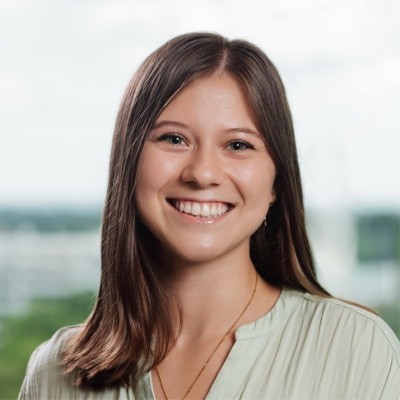
Ellie McTaggart
Co-Founder & CEO of Carolina Instruments
In this episode of Biz/Dev, we sit down with Ellie McTaggart, Co-Founder and CEO of Carolina Instruments, to talk about bringing biomedical technology from the research lab to market, securing funding, and the challenges of building a business in the biomedical field.
Ellie shares her experience developing camera-free eye-tracking technology, navigating grants and funding opportunities, and what she's learning about entrepreneurship as she works to turn scientific innovation into a commercial product.
[00:00:00] Gary: Can it also be used as a very high-powered lie detector?
[00:00:03] Ellora: We've explored that as well. Yeah, that's, it's definitely a compelling one. Yeah. And that's where you get into some of the ethical considerations as well for the use cases is how do you balance the power of the data?
[00:00:17] David: Hi, everyone. Welcome to the Biz Dev Podcast, the podcast about developing your business. I'm David Baxter, your host. Per usual, I am joined by Mr. Gary Voight. Hello, sir.
[00:00:26] Gary: Hello, how are you?
[00:00:28] David: I'm wonderful. I'm wonderful. Actually, I'm getting over a sickness. I shouldn't say that, but other than that, I am wonderful. More importantly, we are joined by the ever difficult to get ahold of Ellie McTaggart, who is the co-founder and CEO of Carolina Instruments. That's plural, y'all. Welcome, Miss Ellie
[00:00:46] Ellora: Hi, David. Thank you so much for having me, and it is indeed plural.
[00:00:50] David: I like to start these out with some warm-up questions. Are you ready? Get to know you a little bit better.
[00:00:56] Ellora: As ready as I'll ever be
[00:00:58] David: All right, here we go. Coffee or tea, and how many per day?
[00:01:03] Ellora: Ooh. Definitely a coffee person. Honestly, I've been a little bit on the energy drinks lately, I'm ashamed to admit. But if I'm on coffee, it's usually two a day
[00:01:12] David: Two a day. You've gotten into Celsius, which is your energy drink of choice, your poison.
[00:01:17] Ellora: Celsius, yeah. That's my poison. They're just so refreshing. When it's colder, the coffee is a little better. I like-- I don't mind a warm cup every once in a while
[00:01:25] David: My daughter got addicted to those and we got all over her about that. Those things are just rough, man. You look at those things.
[00:01:31] Ellora: Yeah. Yeah, not ideal.
[00:01:33] David: First job, what was it, and did you love it or not?
[00:01:37] Ellora: I would say my first job was my first research position that was in high school. Um,
[00:01:42] David: Have any junk jobs? You didn't... I worked at
[00:01:44] Ellora: all my junk jobs were in
[00:01:45] Gary: Target toy department or anything like that,
[00:01:47] David: so you had a cool first job
[00:01:50] Ellora: Yeah.
[00:01:51] David: worked the junk jobs
[00:01:52] Ellora: I had the cool first job, but the first job was unpaid, so that's why I hesitate a little bit is 'cause it was an internship. Yeah.
[00:01:58] David: me your j- first junk job
[00:02:00] Ellora: first junk job would've been boarding dogs through college. So I never had like an em- an employer of any sort. I kinda just had little random side hustles to keep me afloat through college and all of these unpaid research roles.
And so I had to find things that fit around my college schedule and my classes and research, and boarding people's dogs at my house was the great option there. And so I used to have like four dogs at a time and, and would come home and be the crazy lady walking dogs around my neighborhood. So that was my first junk job.
[00:02:30] David: Love it. All right, your biggest miss,
bad luck or a bad call?
[00:02:36] Ellora: My biggest miss
[00:02:38] David: I'm not sure you've ever had a big miss. You're just batting 1,000 right now, but I'll keep at it
[00:02:42] Ellora: I'm thinking, Wow, I guess I feel very fortunate that no big misses are really coming up into my head right
[00:02:49] David: You are a fabulous mix of youth and success that is just unusual. You just haven't
[00:02:56] Ellora: not enough time in the game. They're gonna, they're gonna
[00:02:58] David: give it time. You could be like Gary and just be all misses, until he met me, of course.
[00:03:03] Gary: Are the compliments we talked about,
[00:03:04] David: There it is
[00:03:05] Ellora: Yeah, you guys are so sweet to each other
[00:03:08] David: He's my boo. All right, so let's see here. Ooh, do you have any lucky rituals that you do before any big speeches or big events? Wear any lucky socks or anything?
[00:03:18] Ellora: I, I haven't worn this one in a while. Usually I'm just, petting my dog on the head and heading out the door. But I used to have this watch that was just so ridiculous. It was like a massive kind of a leather band, and it said Boss on it in gold letters, and then the O was the watch face.
And so I used to wear that to all of my conferences, and that was my lucky Boss watch.
[00:03:38] David: There it is. I like
[00:03:39] Ellora: a little bit, so I just keep it in the drawer.
[00:03:42] David: Nice. No I dig that. All right, one more. Let's see here. Ooh, this'll be good for you. Are you the type of person who's gonna retire early or work until you're really old? Where's your head
[00:03:55] Ellora: I see myself working until I'm really old. It would be-- In theory, it'd be great to retire early. But knowing myself I love to stay busy. I think that even if it's not, running a startup I expect to be involved in some kind of job or role where
[00:04:09] David: do you sign up for that FIRE stuff? Financially independent, retire early. Have you heard about all that? A lot of people in your generation are
[00:04:16] Ellora: but I'm just learning about investing now, so we'll see if the early retirement is on the horizon.
[00:04:22] David: So now that I know you a little bit better, I did not know the dog walking thing, that's very exciting. Tell me about Carolina Instruments
[00:04:28] Ellora: Yeah. So we're a, a UNC Chapel Hill spin out from neuroscience research labs. So I-- my background's biomedical engineering, and I worked in these research labs throughout college alongside the dog boarding. And we've created a technology that captures eye motion and pupil size without using any cameras.
And we did that because we wanted to solve a problem that we had in our own neuroscience research, where cameras are very bulky, they take a lot of computation, and it's really difficult to get high speed eye movements from the existing technology. And so our approach removes cameras from the system, and that allows us to get these really high speed eye movements and changes in pupil size that are valuable for understanding internal states of the brain and looking at behavior through eye motion.
And so there's a lot of hidden information behind the eyes that our technology was designed to capture.
[00:05:20] Gary: Now, can I ask a quick question? If you're not using cameras, I know you probably have secret sauce you can't expose, but what are you using to track eye movement?
[00:05:30] David: Magic
[00:05:31] Ellora: Magic. Yeah, exactly.
[00:05:33] Gary: beams.
[00:05:34] Ellora: No we use a basic light-based sensing approach, and so it's similar to the the optical sensing that you have in your watch for capturing heart rate in the Apple Watch and other wearables. But we apply it at the eye, and so we use light-based sensing without camera imaging to be able to capture it at much higher speeds with lower power than cameras do.
So no real images, but we're still capturing the same core information from the system.
[00:06:01] Gary: That's pretty cool
[00:06:03] David: Okay, so I have so many questions. I wanna know how someone... Now, I know if you're not viewing this on YouTube, you do not realize that Ellie is young. And why I'm asking this is, and why this matters is you are working with some PhD peoples who this is their baby, right? So my number one question and this is, it's an absolute
[00:06:23] Gary: I know where this is going
[00:06:24] David: attribute, I don't even know.
How did you convince these old fogies like me and Gary to give you their patent and run with it? You're the CEO of this company, and these people, it's their baby, and they're like, "No, young child, go forth." 'Cause you just got done with your bachelor's, right?
[00:06:45] Ellora: Yep. Yeah. So I didn't do my PhD.
[00:06:48] David: It's amazing. So I- did you do that?
[00:06:51] Ellora: Yeah. I think I still ask myself that every once in a while.
[00:06:54] David: Question
[00:06:55] Ellora: yeah I had come in with almost four years of experience doing research when I joined their labs. And so I definitely had a skill set that was beyond what a undergrad at my stage would've usually come in with. And so I think that was, the first bit of elevation and impression that I got from them.
But then I poured my heart and soul into those labs and working on this project and worked my way up from being a research assistant, building the early prototypes to being the lab manager and showing them that I could keep up with inventory and budget management and things like that. And so I really just kept taking every opportunity that they would give me.
And when I got to the point of recognizing that this was a, a good commercial opportunity, there wasn't anybody else that was there to take it into the company. They're full-time faculty and they have research careers that they wanted to pursue. And I saw that I could take it into a PhD and continue building it in that, or build out the skill set and connect with all the resources at Carolina to take it into a business.
And so I went into the lab manager role knowing that I wanted to explore the company and commercialization path. And then that let me build some of the skill sets that I took in and showed them that I was capable of running something bigger than just a single project.
[00:08:06] David: It's amazing, and kudos to you because I know you get asked that a lot. But it is amazing. And everyone who knows you just talks about how you are this lightning in a bottle, which is very fun for me to chat with you about. So how did you... the, the, the, what's the right word for it? The tangential question, I think that's the right word.
My wife would be so upset with me right now. A lot of the academics, when they have a patent, like this is a common thing when they're talking about a commercialization. I've worked with the commercialization group at NC State, and one of the biggest problems is those patent holders don't wanna let go. You know what I'm saying? They don't... In order to go commercial, you have to kinda let go of the reins a little bit because commercial's very different than academia. Was that a difficult thing, or were they ready to go commercial beforehand?
[00:08:55] Ellora: Yeah I definitely have to give it to them for their mentality through all of this because they had a lot of trust in me. They had a lot of recognition that they were handing off their baby, and that if we wanted to see it be commercially successful, we needed to listen to the advice of the accelerator programs and resources that we were getting access to.
And so I think that I was very fortunate to have faculty members that saw that all the decisions that I was making are to the benefit of getting the technology out there. And so they recognized that we were gonna see a lot of changes and shifts in the way that we were approaching the development and commercialization just by switching into the startup space from academia.
So I think that I was very fortunate that they were as supportive of me as they were as in the early days they were engaged with, all of us going to these meetings and workshops and learning together. And so it was pretty clear, if you go to any entrepreneurial support resources, they-- those-- the information about how different academia and the business world is, is not hard to find.
And so they saw that early on to where when I expressed that I was interested in continuing to push it in that route, there wasn't any resistance from them. It was more this is what needs to happen and, and I'm here asking to do it."
[00:10:05] David: So now to y- again, to your credit, tell me, now it's time for you to brag a little bit. I know you're not gonna wanna do this. But since you've taken over, walk us through all the goodies and gizmos you guys have already won
[00:10:16] Ellora: Yeah, I've try not to forget any. I should have brought a list here, but we've got the NC Idea Micro Grant was the very first piece of support that we got. We had gotten a little bit of market research support from UNC before that while I was still in the university. But after I started full-time, which was required by conflict of interest, I couldn't really work on the company and be in the labs as well.
So I just dove in and landed on the doorstep of NC Idea, got the micro grant, and then around that time we were also applying for SBIR's STTR grants through the National Institute of Health. And those two we've gotten two phase ones of those grants that are about 300K and 400K a piece, and those are what's been supporting a lot of our development now.
But after those were scored well, we've done a few pitch competitions. We won the NextGen Hardware and Deep Tech pitch at Venture Connect last year with CET, gotten into the Grow program and won their demo day, and then also got Carolina Angel Network's March Madness pitch event. And so there's a lot of pitch awards that have come on top of the, the grant funding that we've gotten for the development as well.
[00:11:24] Midroll: We believe that business is built on transparency and trust. We believe that good software should be built the same way. Big Pixel is a 100% US-based, fixed-fee, custom software design and development agency built on transparency and passion. No offshore handoffs, no surprise invoices, just a team that treats your problem like it's our own.
UX and design are core to everything we do. Not a phase that gets handed off, but a discipline that runs through every decision we make. We bring the expertise to build what your business needs and the clarity to know when AI and technology help and when they get in the way. We provide our clients honest assessments of where they are and how they can get where they want to go.
Your idea deserves the right team. Let's talk, plan, and create something that truly works for you.
[00:12:25] David: Okay, so for the idiot in me, I need to understand what you're doing. You're shooting light somehow into your eyes, and you can use that... This is so beyond me. You use that somehow to track the eye 30,000 times a second or something crazy like that, right? That's the gist lo- the easy way of saying it?
Okay. And doing that, are you tracking... i'm thinking of the Vision Pro, right? The big old goggle thing that Apple made that weighs 12 pounds. They have 12 cameras staring at your face to do the same thing, right? Basically. Maybe a little bit more. My question is then, I know you guys are not actually on the product stage, so I'm probably ahead of myself, but is the goal when it comes to devices or the usage of this to be able to track to that level?
They're watching your eye and highlighting an icon. Do you guys get to that level of goodies, or is it still too theoretical at this point?
[00:13:18] Ellora: Yeah. We're still building out our wearable demo, so we've got a lot of those variables that are in the mix as we're building. But in terms of the, the comparison to the Vision Pro, they-- you're right, they have two cameras on for each eye constantly recording, and they are able to get relatively accurate with those with those two cameras on each eye.
But where our advantage is, which you alluded to, is in the sampling speed. And we're not quite at 30,000, we're at 2,000. But
the
[00:13:44] David: I'm
[00:13:44] Ellora: Apple Vision Pro, it would be-- 30,000 would be even more overkill than 2,000 is. So we-- with 2,000, we're able to exceed any of the physiological eye movements that, that happen in those speeds.
But with the Vision Pro, they're sitting at about 100 frames per second, and so we're talking about, about 20X faster sampling speed with the current system. And so what that means for what kind of data can you capture is not only related to where is someone actually looking, but how fast are their eyes moving?
What is-- does the timeframe look like in, in each eye movement that they make and each change in pupil size? Where we capture a lot of additional information that can be used to help classify more things that are related to internal states and engagement and attention levels beyond just what is someone looking at, which is the core value.
[00:14:34] David: But even if you could just do that, that right there is a viable product, right? You guys have been presenting to device things like that because you're like, "Look, we can do at least this." But then you guys get really excited, and I know I've heard you, you talk before where this can go way beyond that and do some really neat stuff.
Is there anything you can talk about there without, someone coming in and swiping me some PR guy?
[00:14:57] Ellora: Yeah. I mean, I can just kind of default and say that we, we can't make any clinical claims yet because there's a lot of applications that we have yet to run studies on and explore. But eye movements in general and, and unique characteristics of them, like their speed, acceleration tremor rate, all of those characteristics are tightly linked to a number of different neurological conditions.
And so we see differences in eye movements and pupil size changes in people with autism, ADHD, traumatic brain injuries, all the way up to neurodegenerative conditions like Parkinson's and Alzheimer's. And so there's a lot of neurological applications for this type of data that we're collecting, which one we, we go on to pursue is, is still up in the air.
But you're right that just having lower power eye tracking in these systems like the Vision Pro is certainly valuable. But where we are excited about the applications is looking beyond that and what can this technology tell us about people and tell them about themselves that they maybe don't know?
[00:15:55] Gary: Can it also be used as a very high-powered lie detector?
[00:15:59] Ellora: We've explored that as well. Yeah, that's, it's definitely a compelling one. Yeah. And that's where you get into some of the ethical considerations as well for the use cases is how do you balance the power of the data?
[00:16:10] David: You've been doing this for years, not just the company, but studying this and the potentials of this. But what is the most exciting thing to you?
Is it just running this company and making something that could potentially be massive, or is it the science-y side of it? What gets you up every day?
[00:16:25] Ellora: Yeah. You know, I'm a, I'm a scientist at my core. Uh, the reason I got into biomedical engineering is because I wanted to create devices that could help people, um, whether it's help them through life or help them understand themselves. And so for me, a lot of the excitement is in these longer term applications.
That's what keeps me motivated. But I would be lying if I told you that I, I wasn't excited every time I saw a new release of smart glasses and looking at all of the applications that those can unlock. And so it's, it's a win-win 'cause I'm a nerd across the board and I, I enjoy a lot of the areas where this applies.
But I think that, that for me personally, it comes down to helping people understand their own behaviors and themselves. So I was diagnosed with ADHD in my junior year of college, and part of the reason that I put so much effort into research and I enjoyed research so much is that I could not take tests well.
I would study, I knew all the material. I would do really well on all my projects, and then I'd get to a test and I would never be able to finish. And that was always related to my ADHD, which I didn't know until my junior year. And once I got that diagnosis, I got extended time and my grades skyrocketed and finally reflected what I felt like the effort that I had put in was.
And so that one moment of recognition for me was so impactful for my grades, how I viewed myself, that I really get excited about the technology being used to help people understand behaviors that maybe they don't have the education or the background or the awareness to be able to identify in themselves.
[00:17:55] David: Very cool. So if you, if, I shouldn't say you, if Carolina Instruments has a green field, my wife gets mad when I call it that, blue sky, green field, whatever, happy times, no major hiccups slowing you down, where are y'all in five years?
[00:18:12] Ellora: I would love to see us, um, embedded into some, some larger smart glasses or headset devices. So, you know, we're a, a core sensing capability. Having eye tracking data is very valuable alone, but it's even more powerful when you use it you know, in tandem with other things like displays and like environmental information.
And so, the way that we're approaching this is we know that there's an interest in smart eyewear and we want to license our technology and build our technology into some more capable smart eyewear devices. But kind of along the side, we are also still continuing to use it for clinical research and explore some of these clinical applications.
And so in five years, uh, you know, I would hope to have some revenue from the early applications in smart eyewear and then be identifying or already pursuing one of the, the cl- whichever one clinical use case we decide to pursue.
[00:19:04] David: Very cool. Yeah, I don't know how it works in terms of timelines, like, 'cause this is almost medical, right? 'Cause it's dealing with human stuff, but I don't know where that line is. Is five years not enough of a timeline? You're still gonna be in testing and crazy stuff with FDA and things I don't understand?
Or is, will you be done with that and you should be on the market by then?
[00:19:22] Gary: Also,
[00:19:23] Ellora: likely that we'll... Go ahead
[00:19:26] Gary: Also is it different between the hardware and the software side? Because I'm sure you can get the hardware working, but then it's the data analysis that's gonna be a little bit more tricky to pass through, like the medical stuff
[00:19:36] Ellora: Yeah. Yeah, absolutely. With the hardware working, we will have it in research studies and clinical research and be generating these data sets that are very valuable because there's not another wearable that can capture at this speed while people are moving around freely. And so we know that we're building something very valuable with the data that we're generating.
And so in that five-year timeline, it's, it very likely that we wouldn't be through the FDA, but we would likely be, going into the official clinical trials for an application that we identify from some of the clinical research work that we've been doing. So just building on that data set is definitely gonna be a core part of where we'll be at that time.
[00:20:14] David: I know the, the trend right now, like Apple does this a lot where with their watch stuff, they will say things like, "This isn't FDA approved, but it- we're gonna go through that process." They're gonna release that sucker the, all their sensors, but we're not gonna say it can do anything except for kind of nudge, nudge, wink, it might look at your heart, right?
Is that just a way around it? Is that the way you have to do it 'cause FDA takes so long? Or are they, is that just 'cause Apple is Apple?
[00:20:43] Ellora: Yeah. Different companies take different approaches. Positioning as a wellness tool is very common because you don't have to take claim over any of the assessments that you make. You're really just saying that you're providing this information for people to interpret on their own. And so when you have to have an a FDA approval as, as, as Gary was mentioning in those algorim- algorithmic design where now I'm saying that this information that I've gotten is telling me that you have this condition or that you are very likely to experience X, Y, and Z health outcomes.
And so if you're not making a conclusion about the data it makes it much easier to position yourself as a wellness tool and just be providing supplemental information rather than going through the whole FDA pipeline.
[00:21:26] David: Are you dabbling at all in the AI assistant sort of thing where, you know how everybody's saying, "Hey, you don't need to hire anybody now. You could just use AI to do it." You're in a perfect position to try that. Are you doing any of that craziness?
[00:21:40] Ellora: I'm definitely dabbling. I've been isolating all of the roles and responsibilities and classifying which ones I want to implement AI for, but I haven't really pulled the trigger on doing that at a large scale. Gemini, of course, I use Google Workspace, and so the Gemini built-in is very helpful for some of the little things.
But I'm working with an advisor in CAM right now to figure out what we really wanna implement and lean into for that, 'cause you're right, it's incredibly valuable to have that as a resource when you're trying to stay lean.
[00:22:08] Gary: So you were an engineer for a long time, and you said you were the only one that saw the business side and went into the business side. How hard is it for you to stay away from dabbling back in the engineering side?
[00:22:19] Ellora: It's definitely hard. You know, I, I get my fair share of, of engineering just from the, the overall project management and setting the goals for the demos and the work that we're doing. I do miss working with my hands every once in a while, but I also realized that one of the skillsets that I had in the labs that I have carried on into the company has been part of why it's been so, smooth for us to integrate ourselves into the local ecosystem, is I love talking to people.
You know, I'm, I'm a talker. And so when it comes to a small team and building something and iterating on it, uh, alone in a room, that's not really as much my thing. I liked the, the engineering in the labs because we were working with neuroscientists, we were getting feedback from them. We'd, ha- to have them test out a device, bring it back, make some iterations.
And so I think that I would be missing the engineering a lot more if I wasn't getting to do as much communicating with people and networking and building the company at the way that I am now. But if I had to totally let go of it and, and not have any idea what was going on with the product development, it would, it would be a little bit harder.
But I think that I'm recognizing that there's a lot of different ways that I can be fulfilled and talking to people and trying to push my dream forward and this company forward is definitely one of them, and I've been enjoying it.
[00:23:30] Gary: You've already seen some success in your first time trying to grow a business or start a business, Makes you jealous, doesn't it? It's gross. success so early, it's
seem jealous. Yeah.
[00:23:43] David: not jealous at all. I don't know what you're talking about.
[00:23:46] Gary: Through everything you've learned
[00:23:47] David: was so useless to the world. Oh my gosh
[00:23:50] Gary: And all the grants and awards that you've achieved that David has not. w- what would you say can stand out as like three pieces of advice you would give someone else trying to start their own business?
[00:24:03] Ellora: Yeah, I think a big one for me is that when I was getting started, you know, I mentioned the conflict of interest layer where I couldn't-- I kind of just had to dive in headfirst into the company to actually see it get underway. But I always encourage people who are wanting to start a company to do all of that customer discovery that we learned in Grow, and really understand what they're going after before giving up their day job and, and committing all the way.
Because there's so much that can be done before you incorporate, before you start to build a product. And so that's my main piece of advice, especially to students that come to me is, is if you have something, go talk to people about it, talk to customers, talk to advisors, because there's so many ways that you can start to flesh out that idea before you let go of that paycheck.
And, um, and I did that pretty early and it, it worked out to my advantage miraculously. But I know a lot of people that have had a much harder time with that, and I definitely encourage people to just take their time exploring and making sure that they really deeply understand the problem that they're solving and the product that they're building.
My second piece of advice. Second one would definitely be just go and talk to the people that are here in North Carolina to support small businesses. So it's one thing to talk to your customers and understand the product and everything, but getting involved with the local support organizations has been huge for connecting me with the right people.
I-- At first, I spent a lot of time just going to networking events and trying to dig my way through a room to find the people that could help me with what I needed help with. But these support organizations like NC Idea, like CED, SBTDC, all of them are made to provide resources to entrepreneurs, and so they can provide some targeted introductions or programming that can be very helpful in those early stages.
And then probably the third one is very generic, but just keeping some kind of work-life balance. It's ironic for me to say 'cause I think that I've been watching mine dwindle and just hanging onto it with a
[00:26:00] Gary: Work-work
[00:26:01] Ellora: with
a thread. Yeah, exactly. I-- my way to do it, I was-- Gary was talking about the skateboards on the back of your walls.
I love going outside and skateboarding or walking with my dog, and it's nothing big, but it's the, those kind of things that if I just sit in front of my computer all day for, 12, 15 hours straight, I will never be able to build this company up to where it should be. And so I just have to constantly remind myself to whatever 15 minutes or 30 minutes that I'm gonna give up to actually live my life is so worth it in the long run to build what I'm building.
And I think I can take some of my own advice every once in a while, but I always encourage people to continue to do that because as you grow and get bigger, it only gets harder.
[00:26:45] Gary: Now, speaking of your company, if anybody wants to learn more about Carolina Instruments or about you, where's the best place to find you?
[00:26:53] Ellora: LinkedIn is a, is a good spot for me. Uh, you can go on there and find our company LinkedIn page that goes to the website. You can con- reach out through the website or on LinkedIn and keep an eye on both of those. But like David said, I've been working very hard to try to stay on top of all of those messages, but I'm very grateful for everybody that does reach out.
[00:27:10] Gary: We'll make sure we include the links into the show notes as well
[00:27:13] David: Miss Ellie, thank you so much for taking the time to join our little baby podcast here. I appreciate it very much
[00:27:20] Ellora: Thank you so much for having me. Good to talk to you and great to meet you, Gary
[00:27:24] David: and on that note, we are out. Thank you for joining us, everyone. We'll be back next week. Bye.
[00:27:29] Outro: That wraps up this episode of the Biz Dev Podcast, and this time you get me, Scott Bailey. I am the lead dev over here at Big Pixel, and I know what you're thinking: "I thought David did all the work." Well, not exactly. We have an awesome team of people to back him up. Biz Dev is a production of Big Pixel, a US-based provider of UX design, strategy, and custom software.
This podcast is edited by audio whiz Matt McCracken and Christy Pronto, marketing guru for Big Pixel. Want to connect? Shoot us an email at hello@thebigpixel.net, or you can find us on Instagram, Facebook, YouTube, X, and LinkedIn.
Recent Episodes
Here are a couple other episodes to check out, or return back to the main page.



AI, Tech, and Industry News
Check out the latest insights, curated with intent, from our team.