The Infinite Pivot w/ Niki Shamdasani

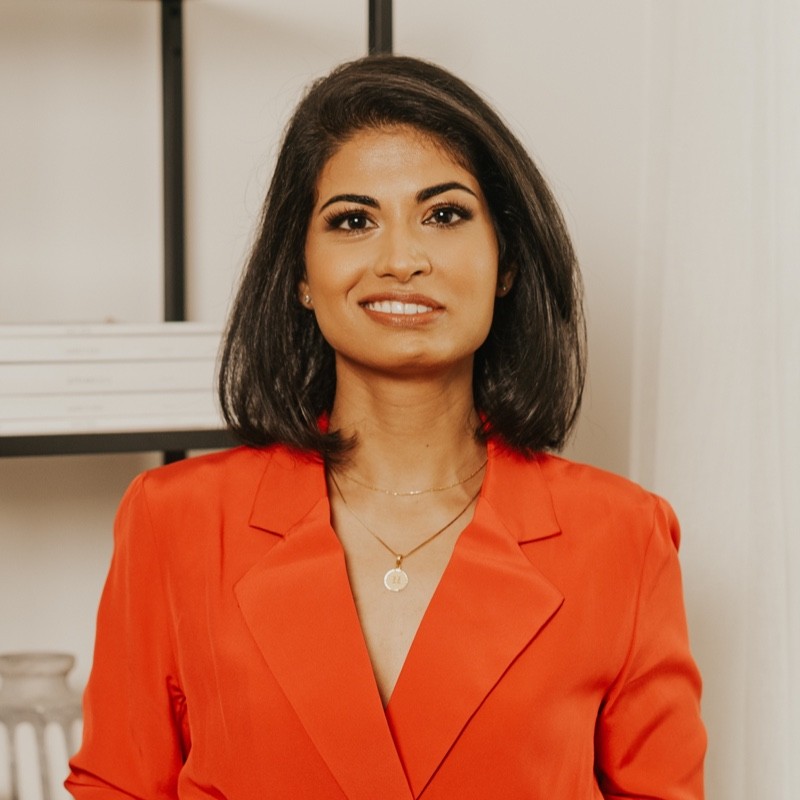
Niki Shamdasani
Founder & CEO of Leo
In this episode of Biz/Dev, we sit down with Niki Shamdasani, founder of Leo and former co-founder of Sani, to talk about entrepreneurship, knowing when to evolve, and what eight years of building a company teaches you the second time around.
Niki shares lessons from growing Sani from an idea into a nationally recognized brand, making the decision to close that chapter, and bringing those lessons into building Leo.
Along the way, we discuss persistence, finding the right customer, trusting what’s working, and approaching your next big idea with a little more experience behind you.
[00:00:00] David: You should move to North Carolina is all it's gonna say
[00:00:02] Gary: Yeah. There's alligators in your wall.
[00:00:08] David: Hi, everyone. Welcome to the BizDev Podcast, the podcast about developing your business. I'm David Baxter, your host, joined per usual by Mr. Gary Vogt. What is up? You're in a different shade of black today. Well done.
[00:00:20] Gary: Technically, this is a blue. Is that a blue? Oh. So it's like a bluish black. Yeah, I go in between.
Nice. The funny thing is- Yeah ... if you look in, we record this with Riverside, and if you look into the graphics of our studio for the past recordings, I'm e- my shirt is like black blue, black blue, black blue.
[00:00:36] David: His shirts- It's all the same shade ... are as interesting as his personality.
[00:00:39] Gary: Black and blue, damaged because
[00:00:41] David: of you.
Nice. Oh, that's- And this ... man, that's beautiful. That's really beautiful. More importantly, we are joined by Nikki Shamdasani, who is the founder of Lio. Welcome, Nikki. How are you?
[00:00:54] Niki: I am good. How are you?
[00:00:56] David: I cannot complain. I cannot complain. Okay, now let's do some icebreakers. We do these. Yep. You have no idea what I'm about to ask you, neither does Gary- Right
for that matter. I like to do these to get to know our guests a little bit better. So here we go. During your commute time, do you, are you a podcast person, a music person, or a phone call person?
[00:01:16] Niki: Now I don't have a commute 'cause I'm working from home, but when I have to go somewhere-
[00:01:20] David: Theoretical commute time
[00:01:21] Niki: when I have to go somewhere, I'm mostly a podcast person, actually.
[00:01:25] David: So what's your favorite podcast to listen to on your commute?
[00:01:30] Niki: I am a big fan of Good Hang by Amy Poehler. Have you all listened to that one? Oh, love Amy. I've seen- Yeah, it's good ... clips on
[00:01:36] David: YouTube of it. I've never actually listened to the
[00:01:37] Niki: podcast.
It's worth it. It's worth it. Okay. She just makes any day better. And then I also like the typical entrepreneurship ones, like How I Built This and The Tim Ferriss Show. I guess that's not just entrepreneurship. But Amy Poehler, I'm such a fan of how she just came into the podcast industry like 10, 15 years later than everyone else and just- And dominated
completely took it over.
[00:02:00] David: It's like these-
[00:02:01] Niki: Mm ...
[00:02:02] David: not huge actors, Amy Poehler is probably bigger than Dax, but came out of nowhere and now they're number two and three. I think still Joe Rogan is number one, right? But it's crazy. Or the Kelsey Brothers. Like, it's weird who makes it on a podcast. It's not just 'cause you're famous.
Of course I, if Taylor Swift came out with a podcast, I'm pretty sure it'd be number one. She wouldn't have to say anything. I think fame maybe have something- Sure ... to do with it, but.
[00:02:26] Niki: Probably. Probably.
[00:02:28] Gary: It seems like, I've listened to a couple of the Amy ones, and it just seems like the guests she has on and the chemistry between her and those guests is just super comfortable.
So it's really easy to listen to, and you feel like you're just sitting in on a conversation instead of listening to an interview.
[00:02:46] Niki: Yeah. I, I- So
[00:02:47] Gary: I think that really connects ... completely agree.
[00:02:50] Niki: Absolutely All
[00:02:50] David: right. Important questions again. Are you a theater girl or are you a wait for streaming girl?
[00:02:57] Niki: I am a wait for streaming girl for most things, but I am actually about to go watch Spider-Man in the theater.
[00:03:04] David: Oh. Do it. Worth it. Yeah, so. Amazing movie. So...
[00:03:07] Niki: Oh, both of you have seen it already?
[00:03:09] David: Yeah. Oh, yeah.
[00:03:10] Niki: Okay.
[00:03:10] David: Yeah, yeah. Okay,
[00:03:11] Niki: good.
[00:03:11] David: And Odyssey is worth your time, too. That's a big... Some movies are good to see on the big screen. Odyssey is one of those. That's a big movie. But most movies, I'm mostly a streamer, but I do like the movies, I should say.
[00:03:22] Niki: Yeah. Yes.
[00:03:22] David: Gary doesn't go out of the house. People tell him to go back in. He's got that restraining order or something. I'm not sure what it is.
[00:03:28] Niki: He's, he's gone, he's gone to Spider-Man.
[00:03:31] David: That was a special case. I mean,
[00:03:33] Gary: just to catch you up, Nikki, every week he has to try to throw some sort of dig just because he's just so jealous, and it shows so often.
[00:03:40] David: Truly what it is, is pure jealousy coming out. Let's see here. Are you more productive morning or late? Morning.
[00:03:50] Niki: Morning? I am such an early bird. Yeah.
[00:03:54] David: Define early. See what one of our PMs gets up every day at 4:00, and I think he's insane.
[00:03:59] Niki: Okay. Yeah, before the sun. Then I'm not an early bird. My ideal is to get up by 5:30, but,
[00:04:05] Gary: uh, right now I'm,
[00:04:07] Niki: like, more 6:00-ish right now, so I don't go to bed early.
[00:04:10] David: Oh, man. You're really sleeping in there. No. All right.
[00:04:13] Niki: Yeah. I... Admittedly, a lot of things have been keeping me up later than I want nowadays, so I'm not getting to be the early bird, but that's my preference.
[00:04:21] David: I understand that. All right. Are you... This is for my wife. Are you a jaywalker or do you go to the crosswalk?
[00:04:31] Gary: Ooh, don't admit anything that c- is gonna get you in trouble. So this is all just allegedly, hypothetically.
[00:04:38] Niki: Yeah. Hypothetically, I don't know that I've ever done this, uh- Yeah ... I am
[00:04:45] David: a jaywalker. My wife is so funny. She is such a non-jaywalker. We can walk a good extra city block to find those white lines in New York City or...
It is crazy how hard... And the kids, again, they're all old, but they're like, "Ma, we're just going to this restaurant here." And she's like, "No. Rarl. We have to go a block around."
[00:05:08] Gary: Let me ask you a question. If you're walking up to, like, a Publix or a Target or some store and there's, they're both sliding doors, but one says enter, one says exit-
will she go into the exit?
[00:05:23] David: No. Here's some- Okay, so here, I'll take that one step further. So there's a Lowe's Foods near us, and after... So they have the ent- enter, exit like you were describing. Yeah. But after 8:00 PM, I think, they close the entrance and they only leave the exit. It's the only one open. And the, watching my wife realize this-
is hilarious. She's wa- desperately wants to go into the entrance. And I'm like, "Honey, that's not open." She, and she's just completely flummoxed. She cannot. Finally she just sighs and goes through. It is so funny.
[00:05:57] Niki: I respect it.
[00:05:57] David: My wife is ultimate rule follower. Ultimate. We love her very much. Hi, Jen. She does listen to this podcast.
She's one of the three people, I think. All right, that's the end of my questions. Very good. Very good. You did well. You get a, a 8 out of 10. I should start grading everybody live just 'cause everyone loves a good grade, right? Just-
[00:06:15] Niki: Of course ...
[00:06:15] David: like you
[00:06:16] Niki: absolutely- I instantly said, "Why only eight?"
[00:06:18] David: Why only... No.
And I'm just gonna be a harsh grader for no apparent reason. You get a four, and just... Why? I'm not gonna tell you. Okay. All right. So I know you from Sani. So tell me a little, just, I know you're not working on that, but just a little highlight what Sani was, 'cause I know it's no longer.
[00:06:34] Niki: Yeah, yeah. I spent the last eight years actually building Sani with my younger sister, and we became...
It started with clothes for Indian weddings, and expanded beyond that to everything you'd pack for a wedding. And we became the first South Asian fashion brand on Rent the Runway and in Nordstrom, and a really big part of it is we grew through founder-led marketing on TikTok and Instagram before everyone was talking about founder-led marketing.
For us it was just TikTok is a cheap way to get the word out there, and
[00:07:09] Gary: in, uh, March 2020
[00:07:10] Niki: when everything shut down, we got on there and started telling the story, and it led us to places we couldn't have imagined. It was a great ride, but we did decide to wind it down in December of this past year.
[00:07:22] Gary: And now-
[00:07:22] David: What was the major reason for the wind down?
Is it just- Money things? Was it, did something shift?
[00:07:29] Niki: Yeah. So many different things had changed about the market, including, yeah, we were selling way more than just the formal wear by the end. But that was, like, that was the product that got us through the door. It was a product that did really well on TikTok and Instagram.
I would call that our hero product. And more and more brands had actually been coming over from India to the US, and they'd been around for decades. They own their own factories. They could afford to even make pieces for much cheaper prices than we could, and it really became a matter of a market change, and the kind of company we needed to be next was not the kind of company we wanted to run.
And I think so much of this, it comes down to energy, and one could probably infinitely pivot. But for us it was like, yeah, whatever is next, that's not the right fit for us anymore.
[00:08:23] David: Fashion. I know there's a lot of people who want to start fashion brands for lots of reasons. They like to design them. They want to do...
It's just something they love. NC State has a whole textiles school, which is insanely compl- competitive to get in. It's a big deal. And I keep thinking to myself, that's gotta be one of the most brutal industries, because you talk about globalization. Globalization changed fashion forever. The idea that... I think there's still Raleigh denim around here, right?
[00:08:50] Outro: Yeah.
[00:08:50] David: And they're making $300 jeans 'cause they have a baby little factory in Raleigh, and they're cranking those things out. Yeah. But how do you compete with a Chinese factory that can create denim for a, a 20th of what you do? And I'm saying China, it could be, there's a million other countries that do it.
True. And I just find that to be, like, such an impossible... The learning curve is almost vertical. Now, maybe you can get a little lifestyle-y brand maybe, right? Maybe, and that's maybe where you guys got to, where you get to a certain point But then either you are doing custom pieces, 'cause that makes sense, right?
Because fast fashion, and we- again, we were talking earlier about my, my kids. My daughter loves some fash fashion, right? Fast fashion. That's hard to say with a lisp. And you have my son, who will only thrift. Mm. They could not be any more different. Right. And it is so interesting, especially in girl space, right?
Fast fashion is just, I can get this blouse for $4? Yeah. Sign me up, right? Brutal business. But you guys got it for eight years, that's pretty amazing.
[00:09:53] Niki: Yeah. Yeah.
[00:09:54] David: You have... And pivot's the wrong word. You have started a new, completely different company-
[00:09:59] Niki: Yeah ...
[00:10:00] David: called Leo. Tell me about that.
[00:10:01] Niki: Yeah, very different space from the fashion world.
So I got super sick from mold a couple years ago. Have either of you had to deal with-
[00:10:10] David: Yeah, my brother in Dallas, it's a big deal in Dallas, like it, it's really... He had... There was a, it was a long story, but there was a period of time where his entire house had two feet of Sheetrock removed- Huh ... for the entire house, 'cause that's where they had to go and fix it, remediate it, and his whole house was see-through.
It was... So yeah, I've seen it. I've never b- he didn't get sick thankfully, but-
[00:10:33] Gary: We did actually have a guest on that was specifically specializing in mold remediation, but through c- like, safe non-toxic chemicals, and they have a branch in the Raleigh area.
[00:10:47] Niki: Is this Psy, Pure Air Pros?
[00:10:49] Gary: Yeah.
[00:10:49] Niki: Okay. It is Psy. Yeah.
You know him? Psy's the one that introduced us
[00:10:53] Gary: Sweet.
[00:10:53] Niki: Cool Sai is awesome. Really great. Yeah. It is a, it's a huge problem, but a lot of people don't even know mold can make you sick. So for me, I actually spent a year going from doctor to doctor until I finally reached someone, 'cause I was fatigued, I had brain fog, hormonal issues.
I was on medicines I didn't need to be on. And so took me a long time to finally reach the person that was like, "You should get tested for mold." And then once my levels came back very high, it took me a long time to figure out where it was coming from. And so I've just been a little obsessed, anxious, and all of the above about this topic for a while now.
And when we wound down Sani, it just started to eat at me again because a, a friend actually was dealing with a mold issue, and so I was going down the rabbit hole with her. And it all led me to this realization where we're all measuring ourselves in 1,000 more ways than ever before. I have an Oura Ring.
I don't know if you all are Apple Watch or yeah-- O- okay, there we go. Whoop bands, all of the above. Um, for me, the largest unmonitored variable for my health was my environment, and nothing was really measuring that. And the simplest framing for what I'm doing now is Leo is the Oura Ring for your home. But we don't just give you the data, we basically route people to a fix, and we're able to even verify it was fixed.
So we are helping make sure that people's homes are healthy. And it's not just mold risk, it's particulate matter, VOCs, a couple of these different things that can make you sick in your home
[00:12:28] David: So is that just a very fancy way of saying you do air purifiers?
[00:12:32] Niki: No. So air purifiers-
[00:12:34] Gary: Sounds like a lot more than just air purifiers.
[00:12:35] Niki: Yeah.
[00:12:35] David: Well, I mean, but at the end of the day, oh, you got mold or... Mold, probably not. But a lot of the things you were saying, air purifier would be the answer, right?
[00:12:43] Niki: Actually, no. Air purifiers are really only the solution if you have a particulates problem. I'll give you another one. VOCs are volatile organic compounds, and they come from a lot of different sources.
They can be cleaning supplies. One thing is even furniture off-gassing or your new mattress off-gassing, and it releases these compounds that can make people not feel well. And air purifiers are really just set up to take into account the particles. They don't do anything for VOCs. You need way more carbon to actually filter that.
And so I would say that actually purifiers are, most people should have them. I think it's a really good baseline thing, but it, you sometimes might not even know that it is solving a problem or that you have something else. It's just like a, a Band-Aid for one type of problem, I would say.
[00:13:33] David: So are you guys trying to remediate or just detect and then tell?
[00:13:38] Niki: We route people to the right vetted local contractor or product or whatever it is. But to be clear, I'm in the early stages. We basically have, uh, an MVP right now and are taking it from there. But no, we even route people to the right fixes, and actually in the closed alpha we did of homes in the past few months, the people ended up, homeowners ended up doing over $50,000 worth of remediations based on our reads.
And to be clear, I don't want people just spending money to spend money, like, where they can. I would like for them to avoid it. But I think it really just speaks to people want their homes to be healthy, and our homes are black boxes right now. And so whatever can help make it not a black box is really important.
[00:14:25] David: So ideally when you're all said and done, you're gonna have a cool little box
[00:14:30] Niki: So right now it's one master sensor basically, but it does feed into an app. And to be clear, nobody can do proper continuous mold detection. Nobody can. There are, you can take air samples, dust samples, things like that, which are one time, often lead to false positives.
No one can do mold detection. I hope we're actually gonna figure that out, but right now for us it's actually mold risk, and we're able to infer that from a bunch of sensor readings and then a bunch of second order variables as well. Actually, AI, not to just throw out the... It is making a product like this more possible than ever before, so it's not just some indoor air quality monitor.
We take a lot of variables into account, like experts, so patterns they've seen, patterns in your house, and all of that taken together helps us infer this is the likelihood of mold risk, this is where we think it's coming from, and a bunch of other details, like a proper diagnosis.
[00:15:32] Gary: Does the reading and evaluation take into account the different geographical locations?
Certain states are gonna have different problems than others, or just if you're in a moister watery area versus a dry, high area.
[00:15:43] David: If you live in hell like Gary does.
[00:15:46] Niki: Yeah. What does that mean? Where do you live?
[00:15:48] Gary: Florida
[00:15:50] Niki: Mm-hmm. Oh, I did not even realize that. I thought you were in Raleigh too. Okay.
[00:15:55] David: No, we wouldn't let him.
He tried, and we kicked him out of the border.
[00:15:58] Gary: That was
[00:15:59] Niki: too cool. Well, Florida is a tough space with a lot of, with a lot of issues, but yeah, we are taking geography into account. I actually think that's a, a huge- Cool ... part of this, especially during humid seasons. Raleigh, it's so hard to actually get fresh air in the house because humidity is at 90% at all times, and I'm guessing Florida is similar right now, so
[00:16:19] David: Just swim through the air there.
[00:16:22] Niki: It's just- Yeah, right. Yeah, pretty much.
[00:16:24] David: Right. So how did... You got sick, but that does not make you an expert. Where did that come from? Like, how did you go from rent the runway to, "I make hardware"?
[00:16:38] Outro: Yeah.
[00:16:38] Niki: First of all, I think that being in the fashion space made me not scared of hardware. Because even to make one piece of clothing, 1,000 things have to go right, and I'd say that's one of the hardest parts.
[00:16:50] David: Making clothes is still hardware, it's just fl- Yeah ... complicated
[00:16:53] Gary: products.
[00:16:54] Niki: Yeah, yeah, exactly. And so that did not make me scared of hardware, but what I did at the start of this year was I started shadowing a mold remediator locally, so actually going into homes with mold. Was it
[00:17:05] David: Psy?
[00:17:06] Niki: It was not Psy.
Although I'm sure that would be very interesting. But I started to basically learn how complicated homes are, which seems like a very basic thing, but I wasn't thinking of them as super complicated, living, breathing entities in many ways, but they are. And then for the actual pilot, we brought on, I'm gonna call them the Sherlock Holmes of homes, who basically have been doing this for 20-plus years.
They're advisors now as well, and so we've definitely gotten a lot of that domain expertise, and I've been in the homes, like, trying to learn from and see what these people come in and do. And so I think it's about having that right expertise, but living it as well. And no one... I, I think that having been sick from it makes me so committed to making sure other people don't get sick from it too, and I think even just having that mission orientation is actually very important for a business like this.
[00:18:12] Midroll: We believe that business is built on transparency and trust. We believe that good software should be built the same way. Big Pixel is a 100% US-based, fixed-fee, custom software design and development agency built on transparency and passion. No offshore handoffs, no surprise invoices, just a team that treats your problem like it's our own.
UX and design are core to everything we do. Not a phase that gets handed off, but a discipline that runs through every decision we make. We bring the expertise to build what your business needs and the clarity to know when AI and technology help and when they get in the way. We provide our clients honest assessments of where they are and how they can get where they want to go.
Your idea deserves the right team. Let's talk, plan, and create something that truly works for you.
[00:19:07] Gary: When it comes to the different kind of things that these devices can detect, have you noticed that while some things might affect some people, if some people have a specific breathing disorder or any kind of other medical issues, other things might affect them very differently? Something that can be completely harmless or not even an issue for one house can be pretty dramatic for someone else who has an upper respiratory problem in another house.
So have you taken into account, like, the scale of medical need a- as well as just general need?
[00:19:38] Niki: Yeah, it's a great point. We don't make any medical claims in general because there is so much variation. Even when it comes to black mold, there are some people- Yeah ... that can process it, their immune system is strong enough or whatever, where it doesn't affect them, and then others, like me, it's, it has a huge impact.
So we don't make any medical claims a- about what in the house, like, could actually be making someone sick. It's just these are factors that we know from a lot of studies, a lot of what's out in the world can cause these things. And what we're seeing, to your point, is that people who might be more immune sensitive, younger kids with asthmas, asthma, allergies, et cetera, they tend to care more about this.
And so that really is our starting customer, people who care already. But I think it's going to become a wider and wider... More and more people are going to be aware of it because companies like the Auras and Whoops have just attuned us to caring more and more about data and everything affecting our health.
And so I'm very interested to see how more and more people start to care about it. But yeah, to your point, it's people right now who already care.
[00:20:51] David: So I wanna change gears here for a second. I wanna nerd for a moment. Nerd. Your company, you started the beginning of this year, is that correct?
[00:20:59] Niki: Yeah. That's when I started doing a lot of my research.
[00:21:02] David: So you are a prime candidate to make one of these AI super companies that you have one person, two maybe, and everything else is bots and gizmos and doodads. Are you leaning that way? Is that something you consider? Is that what you're doing? A super lean, that kind of thing? Or are you going more traditional?
[00:21:25] Niki: I don't think it's either/or. Certainly it's enabling me to do way more than I have been able to do as one person. And I think that for me it's less about how can I just make sure I don't add any more people in, and more about how can I make sure I get the right people to where they can use AI and they're
[00:21:47] Midroll: like
[00:21:48] Niki: 10 people at once.
That's really how I'm thinking about it more, and it's how do we get the very best people and then just supercharge them with everything that AI allows us to do.
[00:21:58] Gary: On the topic of AI, is it, are you guys using AI to help, and like 3D printing and all the newer technologies to help you guys like prototype products and hardware?
[00:22:08] David: Yeah. Yeah.
[00:22:09] Niki: A little bit of 3D printing, but a lot of AI for sure. And it's actually not so much in our case that AI is something that's been slapped onto the product in retrospect. It is more that AI enables this company- Yeah ... to exist when it could not have in the same company- Yeah, you couldn't have done it
a couple years ago. Yeah.
[00:22:32] Gary: Engineering in both software and hardware though probably.
[00:22:35] Niki: Yeah. Yeah, definitely. But I, I... Really the biggest piece of this product is the interpretation layer. So the sensor- Okay ... the, the hardware is really a distribution channel for the software. We need the data, like the physical data from the world to be able to do a lot of what we do next.
But that is really where we are using AI to be able to give people real, um, real clarity on what's happening in their home instead of your PM levels are high or your humidity is high, right? Like that, how, how much does that really do for you?
[00:23:09] David: You're speaking my language only in that I have always been annoyed.
My, I've been an Apple Watch user forever. I have an Oura ring. I'm the whole nerd package. But I don't like ... I'm addicted to my rings- Mm-hmm ... but they don't tell me anything, right? Oura tries. They're getting, they're trying- Yeah ... to say, "Oh, you might be sick," or whatever. But I find it so wildly off most of the time.
Like, I either, I've been sick for a week and they're like, "Hey, you might wanna look and see if your temperature might be elevated." Like, dude, I haven't had a cold for a month. What are you doing? So they're not very good at it yet, but I love the idea that we've been collecting data for a d- uh, 50 years.
Doing something with it is the next frontier, and I, AI I think is a huge part of that 'cause they can do that. But that's where I love the idea that you're speaking, "Hey, we're, we have the data. We're gonna read all this data. But what's, what we're doing that's interesting is the fact that we're gonna tell you an actionable thing with this data."
I think that's been the missing problem with all of these gizmos that monitor all sorts of things. It's just a pile of data and some pretty graphs, and it's still the human that has to make sense of it.
[00:24:15] Niki: Yeah.
[00:24:16] David: Let's, let's take that to the next level. I love that. My last question is, I love, this is my blue sky question.
If you were five years from now, you've had nothing but success- What does Leo look
[00:24:30] Niki: like? There's a Leo device in every single home, including every new home that gets built. And really what we've created is the first real data set of home health records. Just like there are medical records, there are home health records, and that can help in a thousand different ways.
Whether you are buying a new home on Zillow and you wanna be able to see all of the past damage and things like that, what's been fixed, that's in a home health record. Whether you have a contractor coming in and you can't remember when the HVAC system was replaced or what the last person did, that's a part of the home health record.
And I th- I just think that what the-- it's really the byproduct of what we're doing with the sensors and the interpretation layer, but it very quickly becomes one of the im- most important parts of what we can actually give to customers is this home health record. So we're gonna have the largest and greatest data set of homes to basically help everyone understand their homes better.
[00:25:35] David: Love it. Yeah. Gary, wrap us up.
[00:25:39] Niki: And we've been acquired by a great company maybe.
[00:25:42] Gary: I was gonna say, yeah, Apple's gonna put you in their HomeKit products now. Yeah, yeah, yeah.
[00:25:46] Niki: Exactly.
[00:25:48] Gary: Nikki, based on your experience with now your second company that you've started from scratch, what would you say are your top three pieces of advice for any new entrepreneur?
[00:25:56] Niki: Well, this is something that I have to remind myself of every single day, all of these are, but the most important thing in my mind is to shrink the time between when you say you're going to do something and when you actually do it. It is very easy to overanalyze and make something perfect before you do it, but I really believe that action creates clarity, and I am always trying to make sure I shrink that time.
So that's the first thing. The second thing is don't be afraid to be seen trying. When we first got on TikTok, we did a lot of things that are, were, were cringe. We did the dances. We did all of the things, but we knew that this is what we wanted to be doing to try and grow our business. We would do whatever it took.
And I think when people post on LinkedIn, they often feel self-conscious and it, yeah, it's just so easy to feel nervous about what oth- how other people will react
[00:26:54] Outro: to what you're
[00:26:54] Niki: trying to do for your business and your work. But don't be afraid to be seen trying. And then the third thing is I really believe that
[00:27:06] Outro: entrepreneurship
[00:27:07] Niki: is a personal journey disguised as a business pursuit, and that to make it work, you have to become very good at managing your own psychology and just making sure you get better and better every day so you can- Better lead yourself, your company, and your team.
I think always just keeping that in mind is, is... It's been important for me, always trying to get better.
[00:27:31] Gary: Very cool. Now, Nikki, if anyone wants to learn more about you or about Leo, where's the best place to find you?
[00:27:37] Niki: Yeah. I am on LinkedIn, Nikki Shamdasani, N-I-K-I, only one K, not two, and I am on Instagram under the same handle as well.
Those are two of the best places to find me. Leo is at leohealth.co. Not at the .com as yet, but soon enough.
[00:27:56] David: Oh, the squatter
[00:27:58] Gary: problem. We'll put all the links in the- We'll put all the links in the show notes for everybody too.
[00:28:00] Niki: Awesome. Thank you all.
[00:28:03] David: Thank you, Nikki. This has been so much fun.
[00:28:05] Niki: Yeah, it has been.
Thank you, guys.
[00:28:08] Outro: That wraps up this episode of The Biz Dev Podcast, and this time you get me, Scott Bailey. I am the lead dev over here at Big Pixel, and I know what you're thinking: "I thought David did all the work." Well, not exactly. We have an awesome team of people to back him up. Biz Dev is a production of Big Pixel, a US-based provider of UX design, strategy, and custom software.
This podcast is edited by audio whiz Matt McCracken and Christy Pronto, marketing guru for Big Pixel. Want to connect? Shoot us an email at hello@thebigpixel.net, or you can find us on Instagram, Facebook, YouTube, X, and LinkedIn.
Recent Episodes
Here are a couple other episodes to check out, or return back to the main page.



AI, Tech, and Industry News
Check out the latest insights, curated with intent, from our team.